CLIPr Proudly Sponsors SRLEEA Conference in Orlando
At SRLEEA, FBI Director Patel called AI essential for agencies of every size. See how CLIPr is helping small and rural departments do more with less.


Across the country, law enforcement agencies are getting a clear signal from legislators and prosecutors: AI has a place in police report writing, but compliance needs to be at the forefront.
Connecticut’s Chief State’s Attorney imposed a statewide moratorium on using AI to draft or narrate criminal reports. California enacted SB 524 and Utah passed SB 180, requiring agencies to disclose AI use. Prosecutors in King County, Washington and San Diego have restricted AI-first report generation. Minnesota has a bill pending. And the list is only growing.
None of these actions are blanket bans on AI in law enforcement. They target something more specific: the AI-first documentation model, where an AI tool generates a report narrative from a body-worn camera recording and the officer reviews it after. This is where states are cracking down. The alternative is the officer-first model. The officer writes the report from memory in their own words first, and AI assists after — surfacing what the recording captured for the officer to review and selectively include.
This distinction between models is one of the central concerns reflected in these actions. The full picture also includes requirements around disclosure, officer certification, data retention, and vendor accountability. Together, they define what regulators and prosecutors are asking of agencies that use AI in documentation. The critical distinction between these models is at the center of every regulatory action on this list, and it is the line between compliant and non-compliant AI in law enforcement.
When Connecticut's Chief State's Attorney paused AI report drafting statewide, his explanation was direct: "An officer's police report is not simply based on what they hear. It is based on what they hear, see, smell. It can be based upon their fear, their interpretation, many things."
That is the core concern with AI-first report writing. A tool that listens to a body-worn camera recording and produces a narrative is working from one audio input and making inferences the officer never made. Small errors compound fast: a report that references a detail the officer didn't observe, attributes a statement to the wrong person, or fills in a gap the officer would have left blank. When that officer certifies the report, they are attesting under oath to the accuracy of what a computer inferred from limited input.
That raises serious concerns:
• Accuracy risks when reports reference details the officer didn't observe
• Credibility questions in depositions
• Disclosure and discovery complications
• Evidentiary challenges when cases reach court
Prosecutors aren't saying AI can't help. They're saying AI cannot come first.
The pattern is consistent: jurisdictions aren't waiting for a scandal to act. They're drawing the line before AI-written reports reach a courtroom and fail there.
For law enforcement leadership, the question is no longer whether this is coming. It's whether your agency is ahead of it or behind it.
The jurisdictions moving to regulate AI reports aren't acting in isolation — they're responding to a pattern of problems that emerged when AI tools were adopted without the right framework. The agencies best positioned when their state acts are the ones building sound practice now, not the ones retrofitting a vendor relationship after legislation passes. Here are the key considerations for any agency evaluating or expanding AI use in documentation.
1. Do you have a written AI policy?
Utah SB 180 requires a written agency AI policy. California SB 524 assumes one is in place. Connecticut's moratorium was driven in part by the absence of clear guidance at the agency level. A written policy should define which tools are approved, for what purpose, and under what oversight — before an officer uses AI on a single report.
Compliance starts with knowing your jurisdiction's official position. Whether your state has enacted legislation or not, your agency should have clear answers for which AI tools are approved for use in documentation, under what conditions, and who is accountable for how they are used. It is not the role of an AI vendor to define your agency's policy. That accountability belongs to law enforcement leadership and the jurisdictions that govern them.
2. Can your officers explain what AI contributed to their reports?
Both California and Utah require officer certification of accuracy. That certification is only meaningful if the officer knows specifically what AI did — and didn't — contribute. If an officer can't answer that question in a deposition, the certification is hollow and the report becomes a liability.
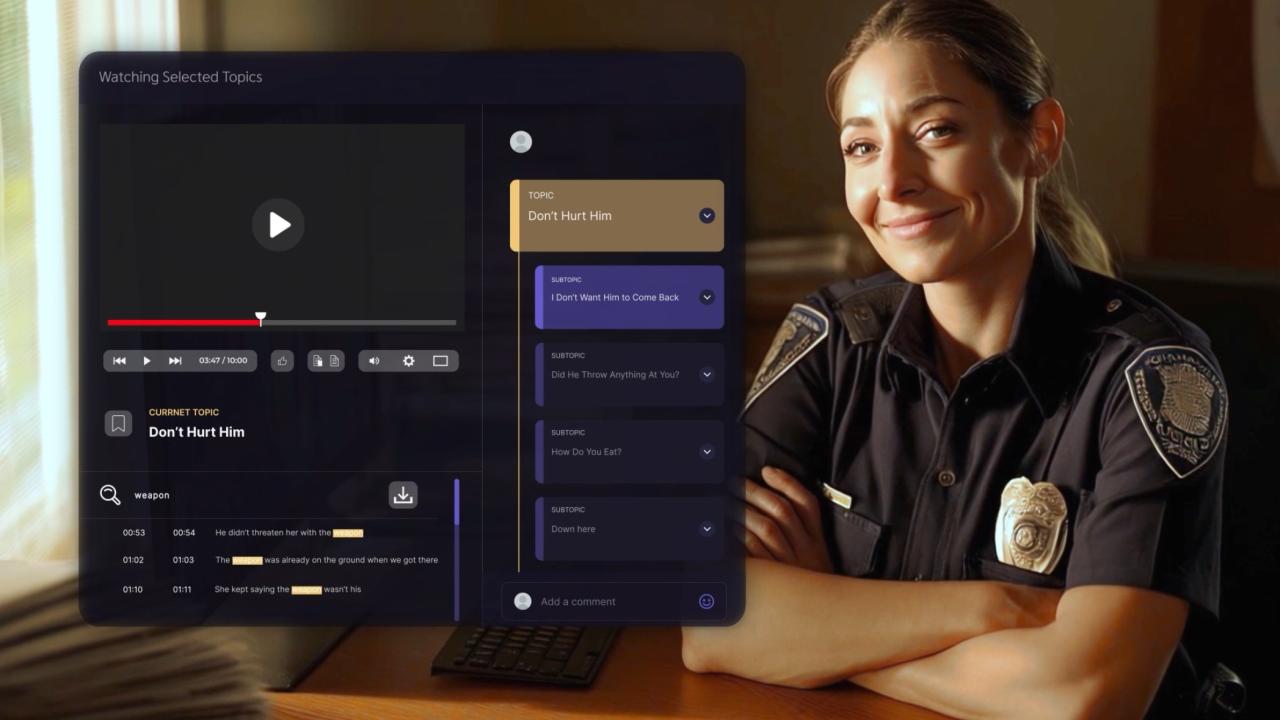
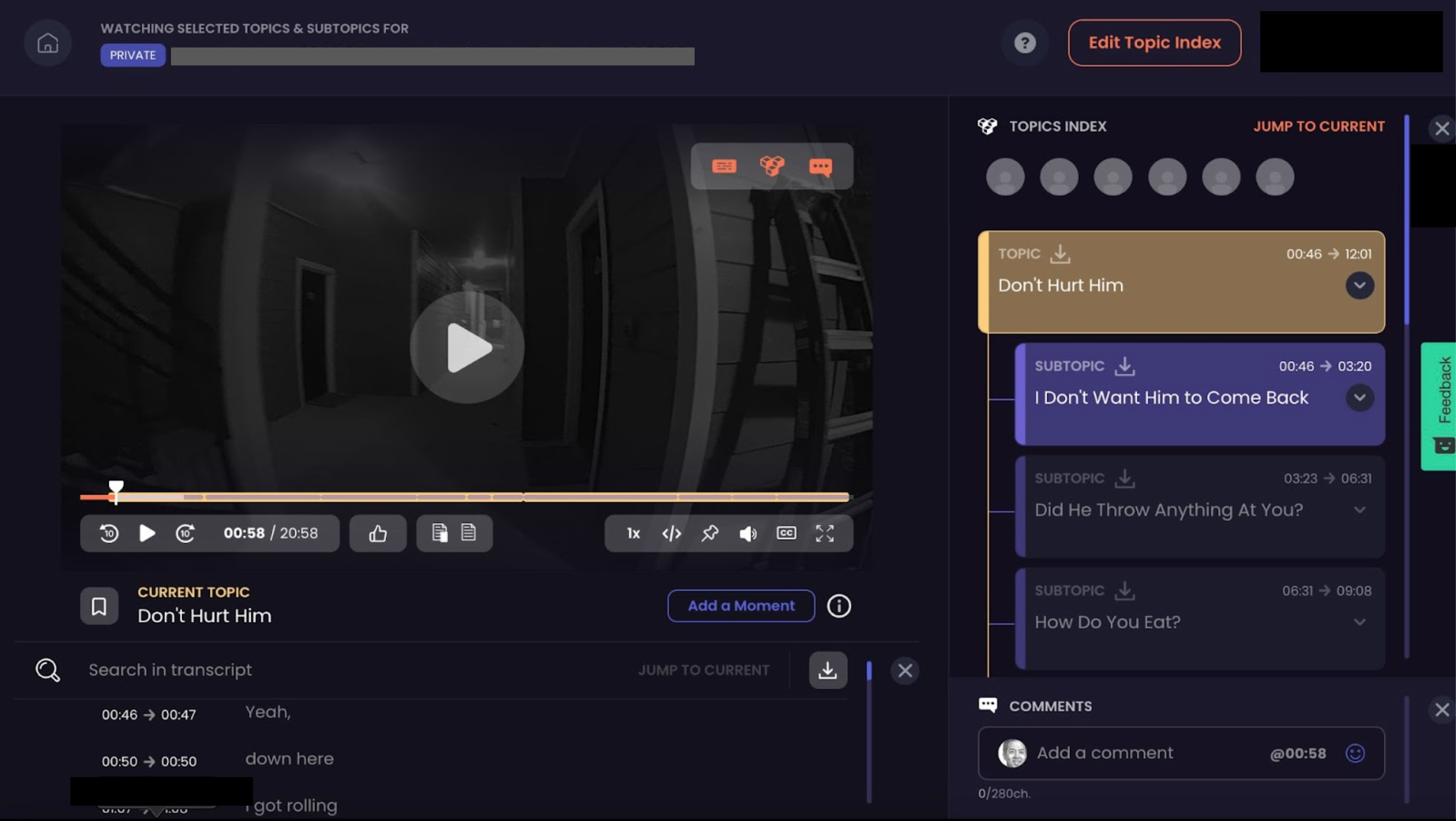
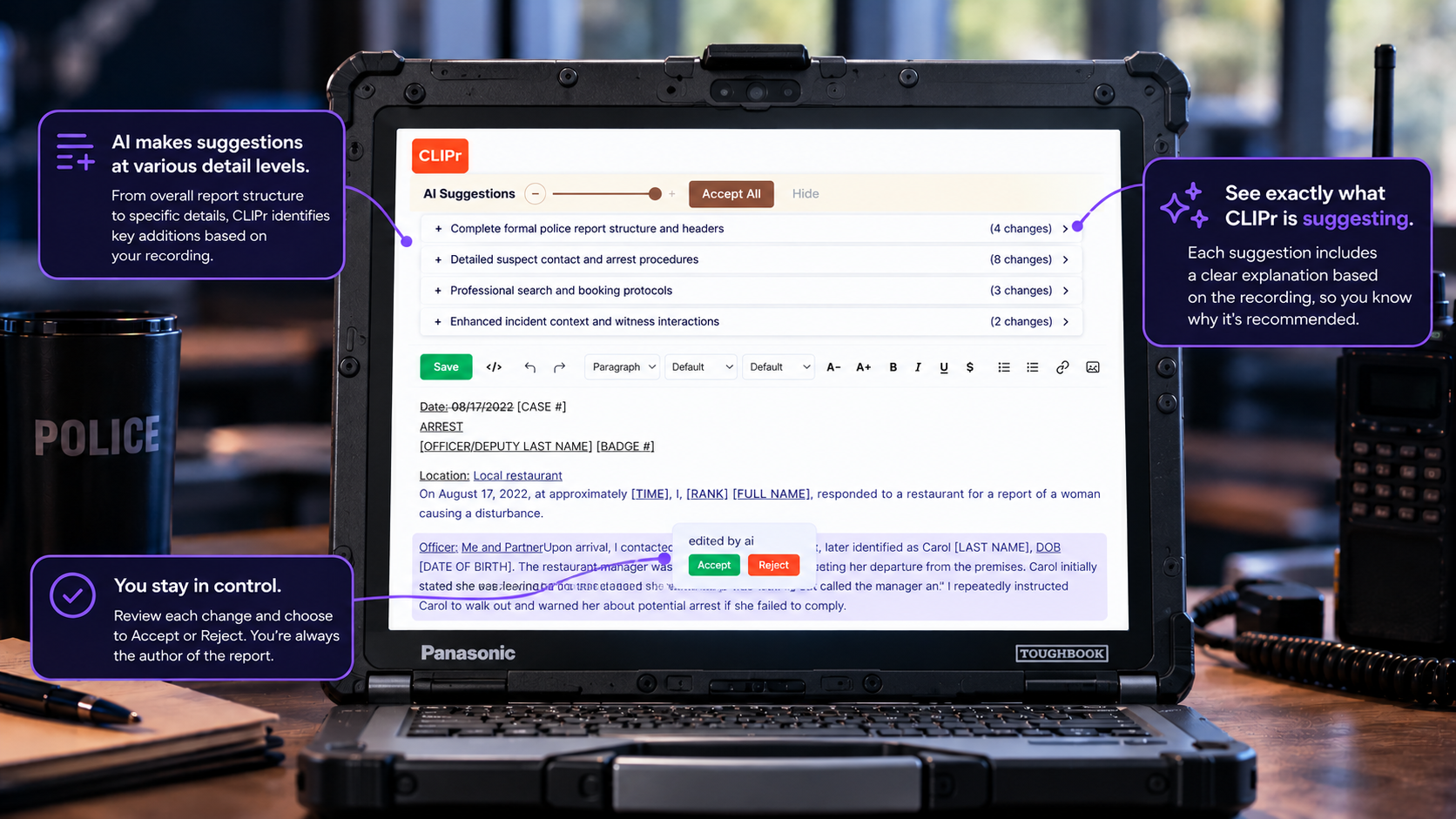
With CLIPr, the officer writes and uploads their report first. CLIPr's AI-Assisted suggestions feature then reviews the body-worn camera recording against what the officer wrote and surfaces a list of specific moments the recording captured that may be relevant to include. The officer reviews each suggestion and hand-picks what to add — or nothing at all. Nothing enters the final report without a deliberate choice by the officer.
Because every addition is a deliberate decision, the officer can account for the full report in a deposition. The officer chooses what to include and why.
3. Is your original AI output being retained?
California SB 524 requires the original AI draft to be preserved for as long as the final report. If your current tool doesn't retain that output separately from the officer-edited version, you may already be out of compliance.
CLIPr retains all versions of a report — from the officer's initial draft through every stage of the review process.
4. Who owns your agency's data, and where does it go?
California SB 524 explicitly prohibits vendors from reselling agency data. CJIS requires strict contractual controls on any third party handling criminal justice information.
Before any AI tool touches a police report, your agency needs clear answers:
• Does this vendor's model train on data your officers upload?
• Who has access to it, and under what legal agreement?
CLIPr does not train its models on agency data. Your data remains yours — it is not used to improve
CLIPr's AI models or shared with third parties.
These aren't hypothetical questions. They are the questions prosecutors, defense attorneys, and state legislators are already asking. Anchoring your AI strategy around them now — before your state acts — is what separates agencies that lead on this issue from agencies that have to catch up.
5. How does your tool support AI disclosure requirements?
California SB 524 and Utah SB 180 both require agencies to disclose when AI has been used in the documentation process. This means your tool needs to make it easy to identify which reports involved AI assistance and what role AI played.
CLIPr flags every report where AI-Assisted suggestions were surfaced, creating a clear audit trail that supports agency disclosure obligations. This metadata travels with the report, so compliance isn't dependent on manual tracking.
Beyond the workflow question, there is a security requirement that most AI documentation tools haven't answered.
The Criminal Justice Information Services (CJIS) Security Policy governs how criminal justice information is handled, stored, transmitted, and accessed. It sets strict requirements for encryption, access control, audit logging, and vendor agreements. For any AI tool that touches a police report — which by definition contains criminal justice information — CJIS compliance is not optional. It is a baseline requirement.
CJIS compliance has been cited by prosecutor's offices as a baseline requirement when evaluating AI documentation tools. Many AI tools marketed to law enforcement are not CJIS-compliant. King County's Prosecuting Attorney's Office specifically flagged this when assessing AI tools: non-compliance with CJIS Security Policy was a central reason existing AI tools couldn't meet their standard.
For agencies evaluating AI documentation tools, ensure those tools are designed to support agency compliance with the CJIS Security Policy. CJIS compliance is the threshold question before anything else.
CLIPr was built around a different principle from the start: the officer writes first, AI assists after.
The officer composes their report from memory, in their own words, documenting what they observed as the primary narrative. They then upload their report alongside their body-worn camera recording. CLIPr's AI-Assisted suggestions feature reviews the recording against what the officer wrote and surfaces targeted additions: specific moments the video or audio captured that may be relevant to include.
The officer controls how much depth they want. A single tap shows a high-level overview of suggested additions. They can request more detail — or none at all. Nothing is added to the report without the officer's deliberate decision to include it. The officer who writes the report is the same officer who determines what goes in it.
This is not a report that AI wrote and an officer signed. It is a report the officer wrote, with AI-Assisted suggestions the officer reviewed and chose whether or not to include.
CLIPr's officer-first approach is designed to address the authorship, transparency, retention, and accountability concerns reflected in California SB 524, Connecticut's moratorium, and King County's guidance on AI in police reporting.
CLIPr is designed to support agency compliance with the CJIS Security Policy from the ground up — not retrofitted to meet a compliance checklist, but built for the security and chain-of-custody standards law enforcement agencies require.
Agencies that establish compliant AI practices now will be ahead of the legislation that follows. The question law enforcement leadership is increasingly being asked is not whether their agency uses AI — it's whether they can demonstrate how it's used and who is accountable for what it produces.
CLIPr's answer is built into the product. The officer is always accountable, because the officer always decides. AI-Assisted suggestions surface what the recording captured. The officer determines what matters and what goes in the report.
That is what compliant AI in law enforcement looks like.
Want to learn more about Compliant AI? Book a demo.