CLIPr Proudly Sponsors SRLEEA Conference in Orlando
At SRLEEA, FBI Director Patel called AI essential for agencies of every size. See how CLIPr is helping small and rural departments do more with less.


A practical map for command staff, records leaders, and procurement: the AI use cases that pay off today, the ones that concentrate legal risk, and the policies and audit trails that keep a deployment defensible.
If you run a US police department or sit in its records or legal chair, AI is no longer hypothetical. Report writing, video review, vendor pitches, and AI-assisted reports are already on your desk.
The question is how to deploy AI without legal exposure or a workflow officers abandon. By 2016, 47% of general-purpose law enforcement agencies had already acquired BWCs, including 80% of the largest departments, so the footage and documentation burden already exist.
This guide maps where AI in law enforcement works today, where risk concentrates, and the policies, audit trails, procurement questions, and 30-60-90 rollout that keep adoption defensible. It sits within the broader shift in technology and policing, but stays focused on practical decisions.
Not all AI use cases carry the same risk. The useful mental model:
Decision rule
AI that documents and organizes evidence is low-controversy and high-value. AI that identifies or predicts people is where the legal and civil-liberties risk concentrates.
The DOJ COPS Office covered AI report-writing tools in January 2025, naming real products, benefits, and cautions. The OJP/NIJ landscape study of generative AI in criminal justice (June 2025) reached the same posture: genuine utility, conditional on governance. Four zones matter for most agencies.
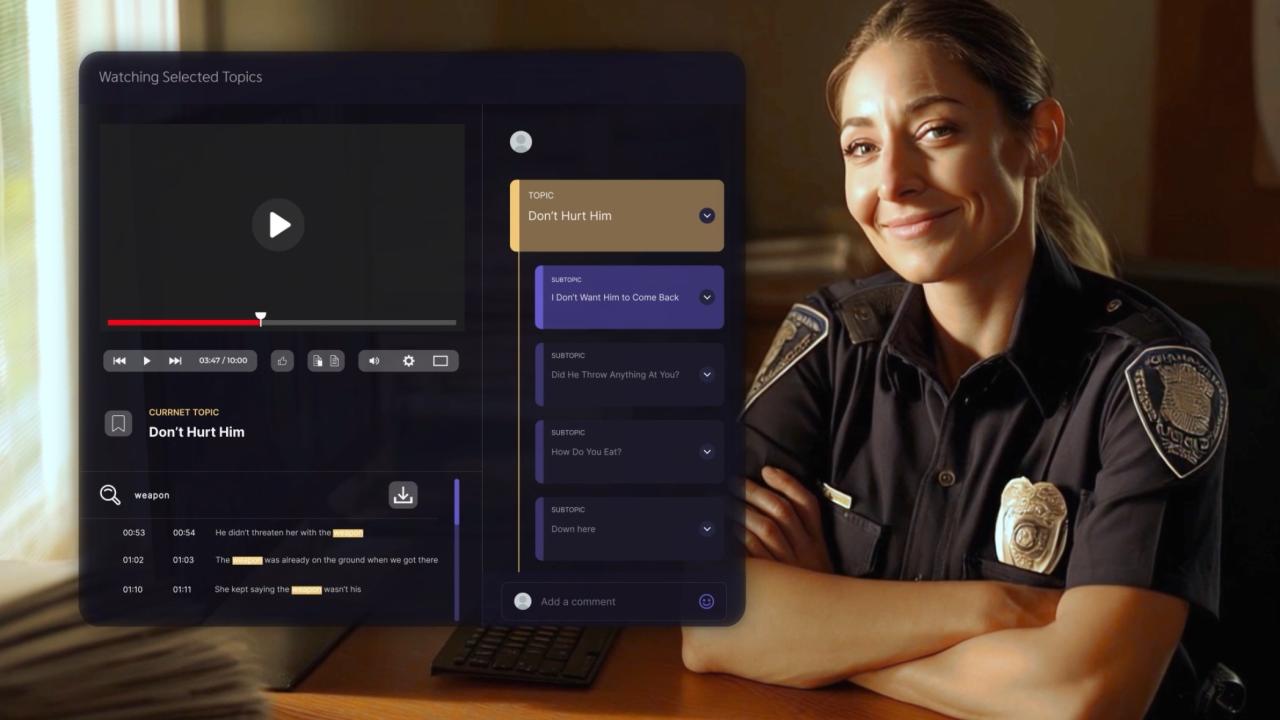
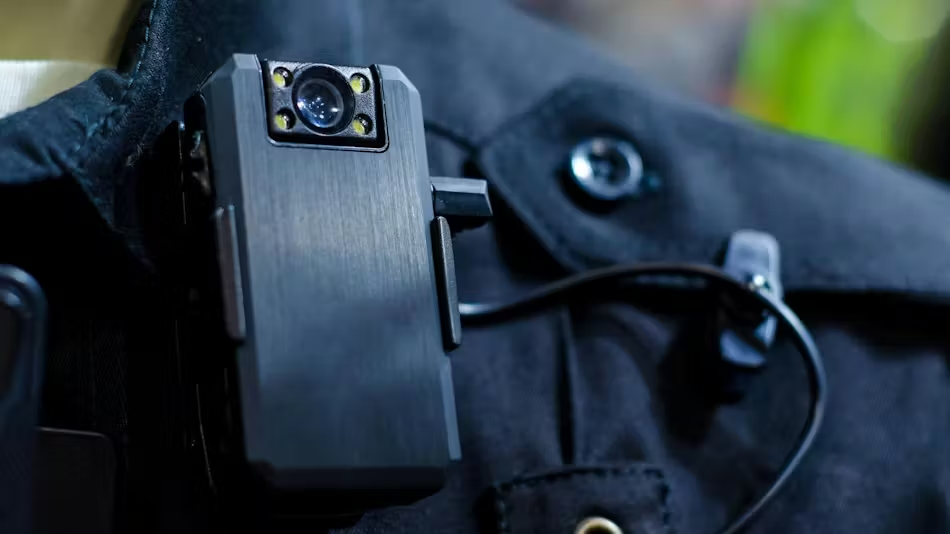
This is one of the more mature use cases, with guardrails agencies can define before rollout. AI converts BWC or dashcam audio into a first-draft narrative, the officer reviews and edits it, then submits it through the normal RMS workflow.
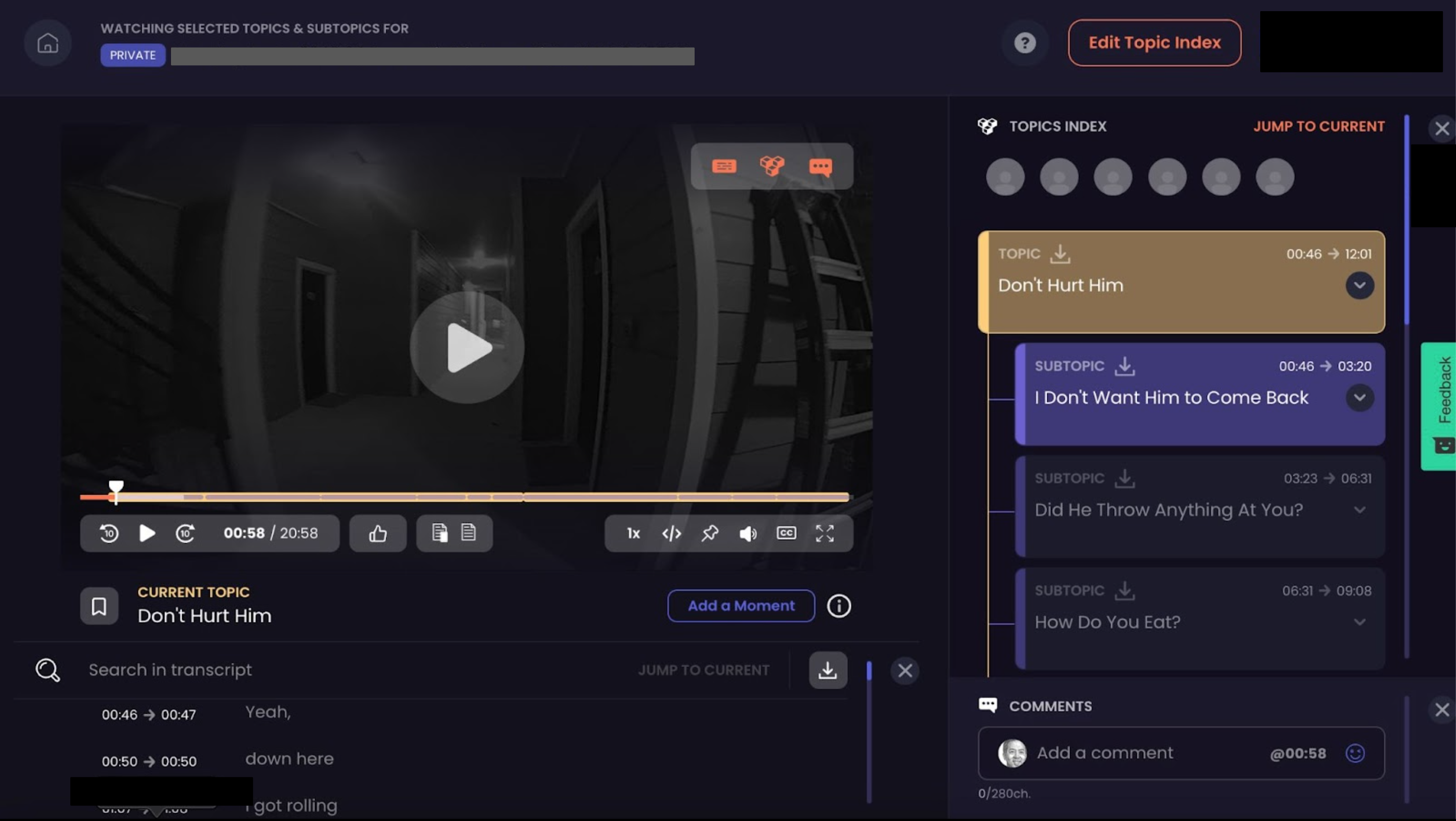
The benefit is field time: CLIPr lets an agency drag and drop BWC or dashcam footage from its existing evidence platform, then gives the officer a draft to review and edit. The officer stays the author of record, and agencies can start without new hardware before adding dock-to-auto-upload or RMS handoff later.
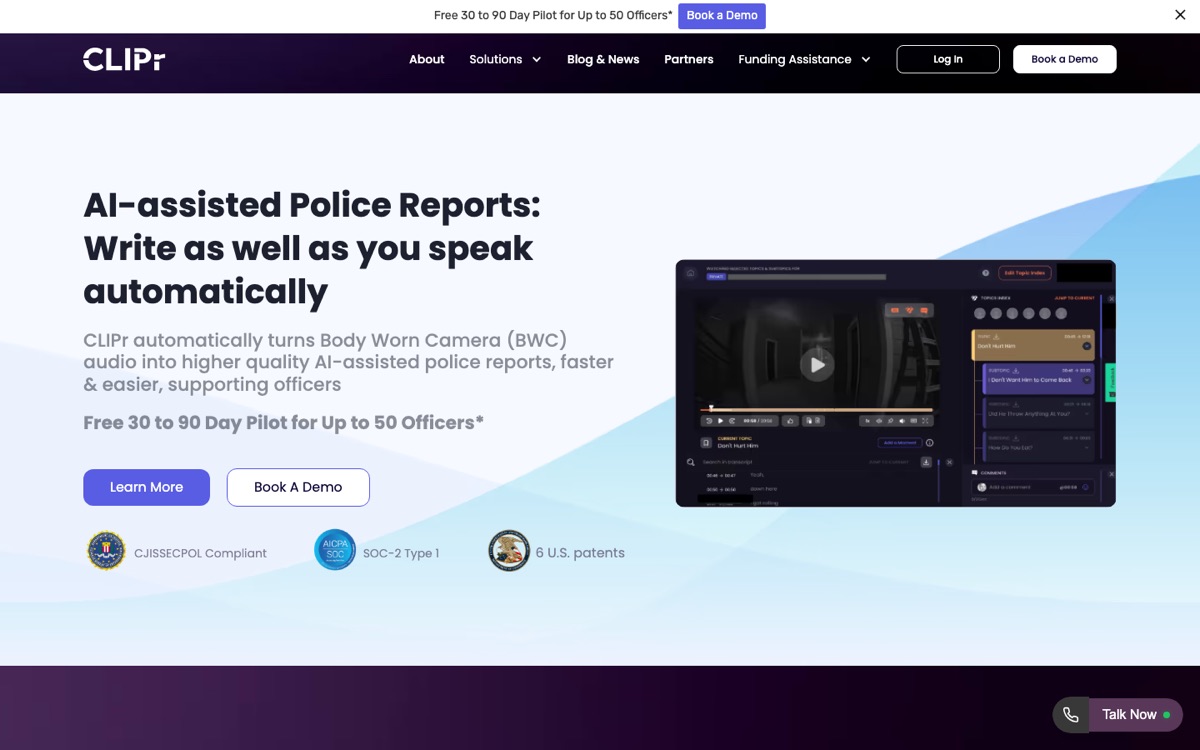
Baseline controls: the officer reviews and signs every draft, AI use is disclosed, the first draft is retained, and the system logs who generated and edited what.
California has already made several of these requirements mandatory for covered agencies, but the better way to read SB 524 nationally is as a future-proofing benchmark, not the current legal baseline for every state.
For a deeper look at how this workflow runs day to day, the AI police report generator breakdown covers draft quality, review steps, and RMS handoff in detail.
Detectives lose investigation time to a quieter version of the same problem. A suspect interview runs over an hour, then someone has to re-watch it, transcribe it, and pull the moments that matter into a report.
AI handles the mechanical layer well: speaker-identified transcripts, timestamps, keyword search, and summaries that link back to the source recording. CLIPr's detective interview-room reports apply this to suspect, witness, victim, and field interviews, producing searchable first drafts that integrate with existing RMS and evidence platforms.
The same applies to patrol video; bodycam transcription software is the natural starting point if the backlog is footage rather than interviews.
Key control: every AI summary or excerpt should link back to the original evidence segment. A summary is a finding aid, not evidence.
Records teams face statutory deadlines with footage volumes that manual redaction cannot keep up with. AI-assisted redaction finds faces, plates, screens, and PII fast; a human verifies before anything is released.
This can be a lower-risk place to start because the review happens before release. CLIPr offers redaction as a service in both a self-serve and a white-glove model, with human verification before release and an audit trail.
Key control: human sign-off on every release, plus a documented chain of who redacted and verified what.
Facial recognition and predictive policing are where AI in law enforcement has drawn the highest public scrutiny, including documented wrongful arrests from false matches. The ACLU's Williams v. City of Detroit case became the reference example, and reporting has continued to surface misidentification cases since.
These tools sit in a different governance class: an AI match should be treated as an investigative lead, not probable cause on its own. If your agency uses them at all, require independent corroboration.
Require supervisor sign-off and explicit documentation of how the match was handled.
Many agencies conclude the safer answer is not yet. That is a legitimate policy outcome, not a failure of imagination.
Use this to decide what is lower-risk to pilot now and what each use case demands before go-live.
| Use case | Benefits | Key risks | Baseline controls | Courtroom note | Pilot posture |
|---|---|---|---|---|---|
| Report drafting from BWC audio | Less report time, more field presence | Hallucinated details, over-reliance | Officer review + signature, AI disclosure, first-draft retention, audit trail | Preserve draft + source media for discovery | Ready to pilotwith policy in place |
| Interview transcription and summarization | Faster case prep, searchable evidence | Misattributed speakers, missed context | Speaker verification, links to source segments, human review | Transcript is an aid; recording is the evidence | Ready to pilotwith review step |
| Video redaction for FOIA | Meets deadlines, shrinks backlog | Missed redactions, over-redaction | Human verification before release, audit trail | Document redaction rationale per request | Ready to pilotwith sign-off gate |
| ALPR analytics integrations | Faster vehicle leads | Data sharing creep, stale hits | Access controls, retention limits, query logging | Log the basis for each stop | Pilot carefullywith tight access policy first |
| Facial recognition | Lead generation on serious cases | Wrongful identification, bias | Lead treatment, corroboration, supervisor sign-off, disclosure | Do not use as the sole basis for arrest | Strictly limitor decline based on agency policy |
| Predictive policing | Resource allocation efficiency, hotspot-informed patrol scheduling (vendor-claimed) | Historical arrest data can amplify bias; evidence base is mixed and often weak | Independent validation, data provenance review, community transparency, human command review | Expect aggressive discovery challenges | Narrow approval requiredlegacy predictive models amplify historical bias; current practice increasingly favors real-time resource allocation over behavioral prediction |
Distilled from the guidance cited in this guide: DOJ COPS Office, OJP/NIJ, NIST AI RMF, CJIS v6.0, and California SB 524.
One policy line per use case, ready to adapt:
Frameworks are useful when they turn into lines in your policy manual. Three layers apply to US agencies right now.
The NIST AI Risk Management Framework 1.0 is the de facto US governance baseline, organized around four functions: govern, map, measure, and manage. Its Generative AI Profile adds the risks that matter most for report drafting, including confabulated content. Practically: name an accountable owner, inventory every AI tool in use, and define how you measure accuracy and handle failures.
Any AI tool touching criminal justice information should be evaluated against your CJIS Security Policy v6.0 posture (released December 27, 2024). The controls that matter most for AI vendors include access control, MFA, encryption, and audit logging.
A useful vendor conversation covers how the platform aligns with the CJIS Security Policy controls that apply to your deployment.
This is where requirements get concrete fast:
For agencies that want a starting point, this snippet covers the requirements above:
One context note for completeness: the EU AI Act bans certain practices outright, including real-time remote biometric identification in public spaces with narrow exceptions, with prohibitions effective February 2, 2025.
It applies in the EU and is informational for US agencies, but it previews where regulatory pressure is heading.
A useful AI tool should not trade report time for courtroom risk. Run every AI deployment decision through one question:
What will the defense ask for, and can you produce it?
The defensibility checklist:
The police report writing software market has grown crowded, and vendor pages can be hard to compare. The NIST Generative AI Profile supplies useful procurement questions; this checklist translates them for police buying.
For orientation, the report-drafting category includes tools like Axon Draft One, Code Four, and Flock Nova, alongside CLIPr. Tools in this space vary in focus; confirm each vendor's current report-drafting capabilities directly. These are examples, not endorsements; the checklist above matters more than any logo. If you are actively comparing vendors in this space, the Truleo alternatives rundown separates analytics-first tools from report-drafting tools, and the wider law enforcement software hub covers adjacent systems.
Field failures show where policy has to be specific. Three patterns are worth studying:
Robert Williams was arrested after a false facial recognition match, and the resulting ACLU case against Detroit drove major policy changes in how the department uses the technology. Misidentification cases have kept appearing in reporting as recently as 2026.
Treat a match as a lead, corroborate independently, and document the corroboration.
Generative tools can state details with confidence that the recording does not support. The NIST Generative AI Profile calls this confabulation and treats it as a core generative-AI risk.
The officer reads every line against memory and, where needed, the recording, then signs before submission.
As news coverage of agencies adopting AI-assisted reports shows, scrutiny from watchdogs and prosecutors arrives with the rollout, not after it. The federal government is moving fast too: the DOJ's public AI inventory grew roughly 31% in 2025.
Align policy and prosecutor expectations before the first AI-assisted report is filed.
For agencies between 25 and 250 sworn, this sequence keeps governance and workflow fit in front of adoption.
It also follows the crawl, walk, run path CLIPr is built around: start by dragging and dropping footage, add dock-to-auto-upload once the workflow proves out, then push the certified report straight into the RMS. That is the practical version of CLIPr's AI: Your Way posture: start with the workflow you have, then add automation and integrations when they fit.
A fuller version lives in the guide to how to automate police reports.
The most established uses are documentation and evidence work: drafting police reports from BWC audio, transcribing and summarizing interviews, searching video evidence, and redacting footage for public release. Identification and prediction tools (facial recognition, predictive policing) exist but carry far higher legal risk, as the DOJ COPS Office and the OJP/NIJ landscape study both note.
AI-assisted draft text can be used when the agency follows applicable law and policy: a human officer reviews, edits, and signs the report; AI use is disclosed where required; and the first draft and audit trail are retained. California SB 524 made these explicit legal requirements for covered California agencies as of January 1, 2026. Elsewhere, they are a sensible future-proofing default to discuss with counsel and prosecutors.
Three layers: the NIST AI RMF and its Generative AI Profile for governance, CJIS Security Policy v6.0 for any system touching criminal justice information, and state laws such as California SB 524 and Utah's generative AI policy requirement.
Cautiously, if at all. Documented wrongful arrests, including the Williams case in Detroit, show the failure mode is severe. Agencies that proceed should treat any match strictly as an investigative lead, require independent corroboration and supervisor sign-off, and document both. Many agencies reasonably choose not to use it yet.
Line by line, against their own recollection and the recording where anything is uncertain, before signing. The fundamentals of how to write a police report still apply; AI changes who types the first draft, not the standard the final report must meet. Strong police report writing examples help calibrate officers on what a finished, court-ready narrative looks like.
The agencies getting value from AI in law enforcement tend to be the ones that picked a low-risk documentation use case, wrote the policy first, briefed the prosecutor, and measured the pilot honestly.
A practical first step is available this week: work through the LE-AI Readiness Scorecard, adapt the six-line policy snippet to your agency, and pick the workflow where the time drain is most obvious. For most departments, that is report writing from BWC audio.
When you are ready to test it on real shifts, CLIPr's AI for law enforcement platform offers a free 30 to 90 day pilot for up to 50 officers, is designed around CJIS Security Policy alignment, and supports a workflow that can end where your reports already live: in your RMS. Deployment-specific security and data-handling details should be reviewed during procurement.
CLIPr turns BodyCam and DashCam audio into AI-assisted police report drafts that officers review, edit, and copy into their RMS. The platform is designed around CJIS Security Policy alignment and SOC 2-oriented controls. Agencies should confirm current documentation, ownership, retention, and deletion terms during procurement.
Run CLIPr with your own bodycam footage. Free 30 to 90 day pilot for up to 50 officers, no credit card required, subject to approval.