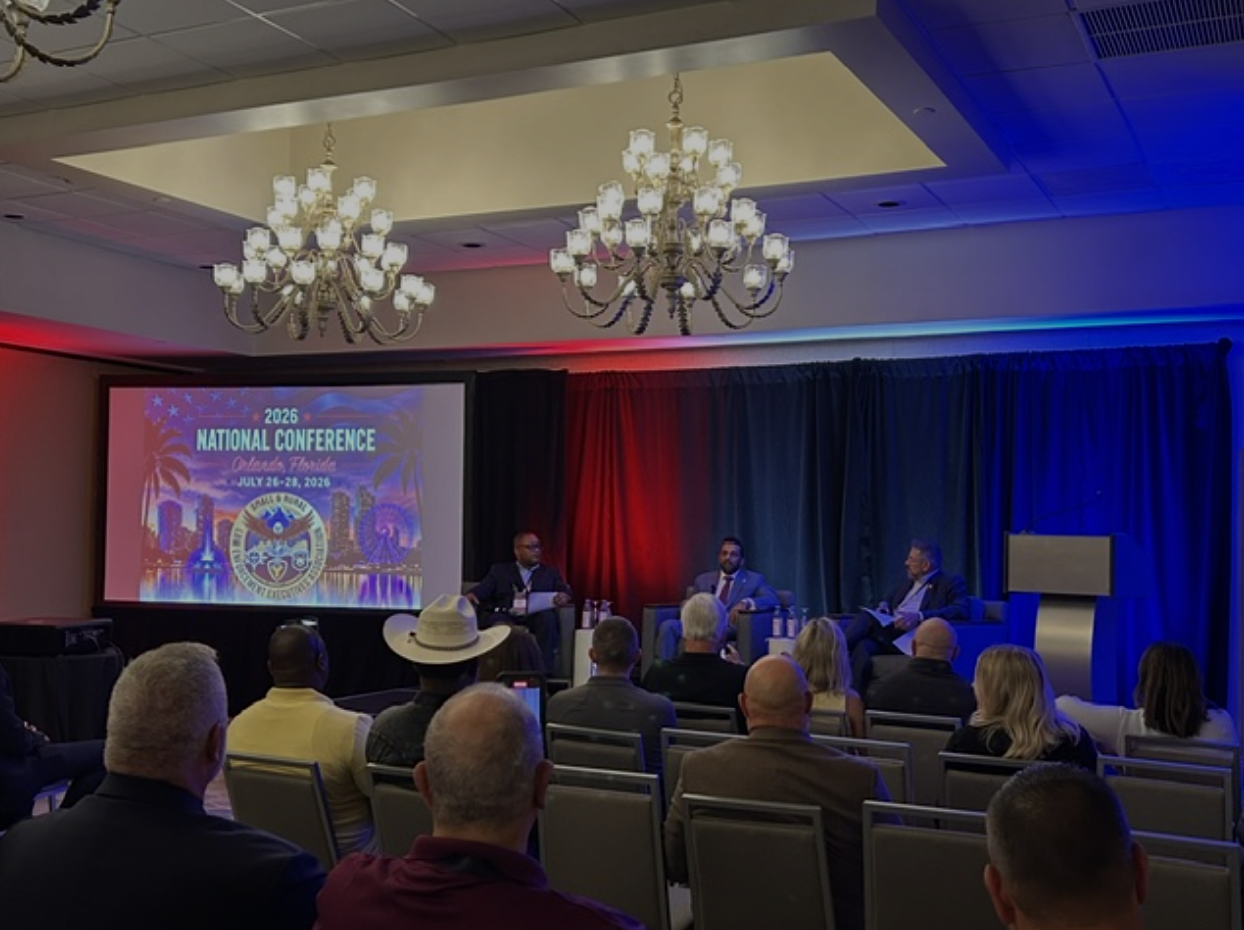
CLIPr Proudly Sponsors SRLEEA Conference in Orlando
At SRLEEA, FBI Director Patel called AI essential for agencies of every size. See how CLIPr is helping small and rural departments do more with less.


10 bodycam transcription tools compared against six law-enforcement-specific criteria, with one comparison table and a decision framework you can explain to a chief, an IT director, or a city council.
Command staff, records leaders, and project leads evaluating bodycam transcription software usually arrive with the same problems: officers losing field hours to report writing and video review, records teams buried in FOIA requests, and IT asking about chain of custody.
Vendor pages do not make the evaluation easy. Axon and Motorola bundle transcription inside evidence platforms, specialist vendors publish capability lists without prices, and few explain how transcripts get into your RMS.
This guide compares 10 bodycam transcription tools against six law-enforcement-specific criteria. It ends with the BWC-TRUST scorecard you can use to explain your pick. Most vendors offer pilots or trials, so testing a BWC-to-report workflow can happen without rip-and-replace.
A transcription tool that works for podcasts can fail badly in a police department. These six criteria reflect what actually breaks during law-enforcement deployments.
Good looks like
Audit trails, clear data handling, and transcripts that stay linked to the original recording.
Bad looks like
Audio leaving your evidence environment with no record of where it went.
Good looks like
Transcripts appear inside your DEMS (Evidence.com, CommandCentral) or export cleanly to your RMS.
Bad looks like
Officers copy-pasting between browser tabs.
Good looks like
Speaker diarization, timestamps, in-transcript search, and translation options where your community needs them.
Bad looks like
A wall of unlabeled text.
Good looks like
Automated processing with predictable delivery and a notification when the transcript or draft is ready.
Bad looks like
A queue you cannot see into.
Good looks like
Published law-enforcement security statements, SOC 2 documentation where applicable, and clear ownership, retention, deletion, and data-handling terms.
Bad looks like
A trust page with no specifics. A generic badge is a starting point, not proof of CJIS Security Policy alignment; it helps to review the controls, documentation, and data-handling terms behind it.
Good looks like
A pricing structure that matches your volume (per-minute, license, or bundle) and a pilot before you commit.
Bad looks like
Opaque pricing plus a multi-year contract on day one.
Use this rubric to rate any shortlisted tool from 0 to 5 on each dimension. It compresses weeks of demo calls into one defensible score.
Three scoring rules keep it honest:
| # | Product | Likely fit | Pricing | Compliance signals |
|---|---|---|---|---|
| 01 |  CLIPr Report-ready workflowsBWC audio to AI-assisted report drafts
|
Agencies that want report-ready transcripts and drafts across existing cameras, from small departments to larger county, state, and sovereign deployments | Searchable Audio $0.105/min; Searchable Video $0.21/min; free 30 to 90 day pilot | CJIS Security Policy-aware posture, SOC 2 architecture signal, and data-handling terms to confirm in procurement |
| 02 |  Axon Auto-TranscribeTranscription layer inside Axon Evidence
|
Axon-standardized agencies | Add-on; unlimited version included in OSP7+ Premium | Axon Evidence ecosystem controls |
| 03 |  Motorola CommandCentral EvidenceAssisted transcription inside CommandCentral
|
Motorola/WatchGuard stacks | Custom, bundled with CommandCentral | Motorola public-safety ecosystem |
| 04 |  VIQ Solutions FirstDraftAutomated drafts with human review
|
Agencies that want human-verified transcripts | Custom | Law-enforcement-focused workflows |
| 05 |  VeritoneaiWARE transcription plus redaction
|
Multi-language transcription plus redaction at scale | Custom | SOC 2 claims published on site |
| 06 |  CaseGuard StudioTranscription inside a redaction suite
|
In-house redaction teams | Custom, quote via pricing form | In-house processing control |
| 07 | 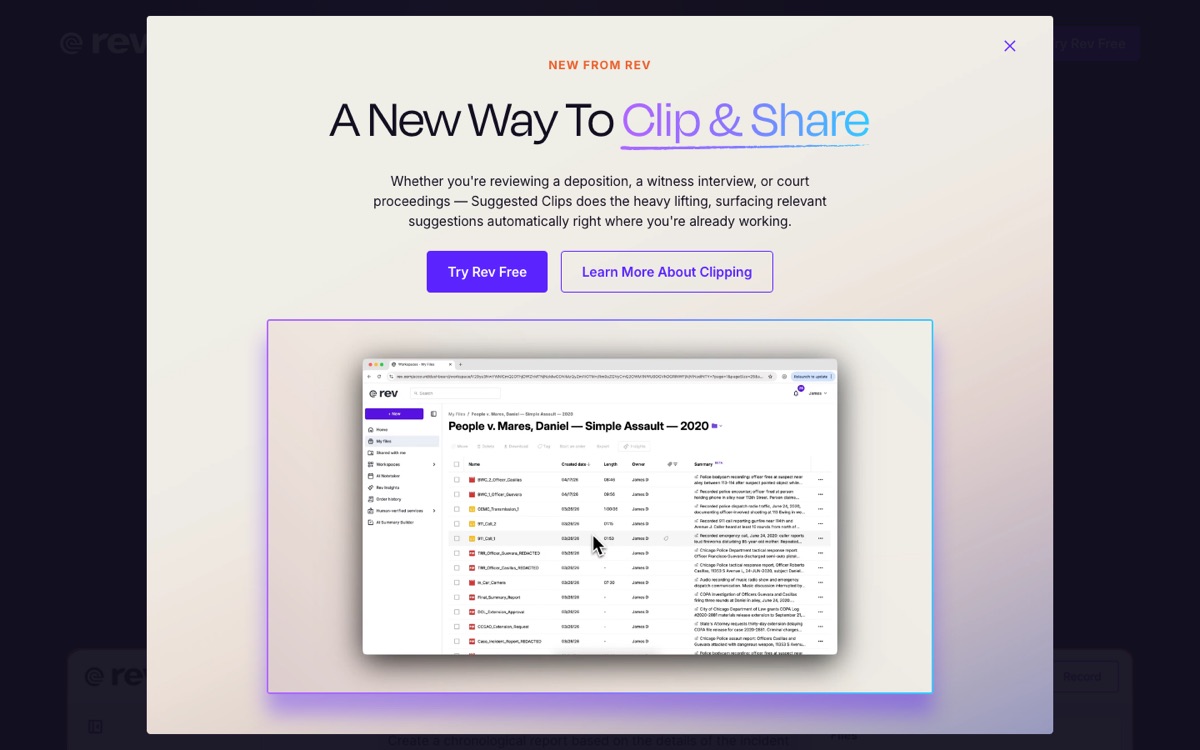 RevAI and human transcripts on demand
|
Low-volume, pay-as-you-go needs | $0.25/min AI; $1.99/min human (as published by the vendor, last checked July 2, 2026) | General-purpose service |
| 08 | 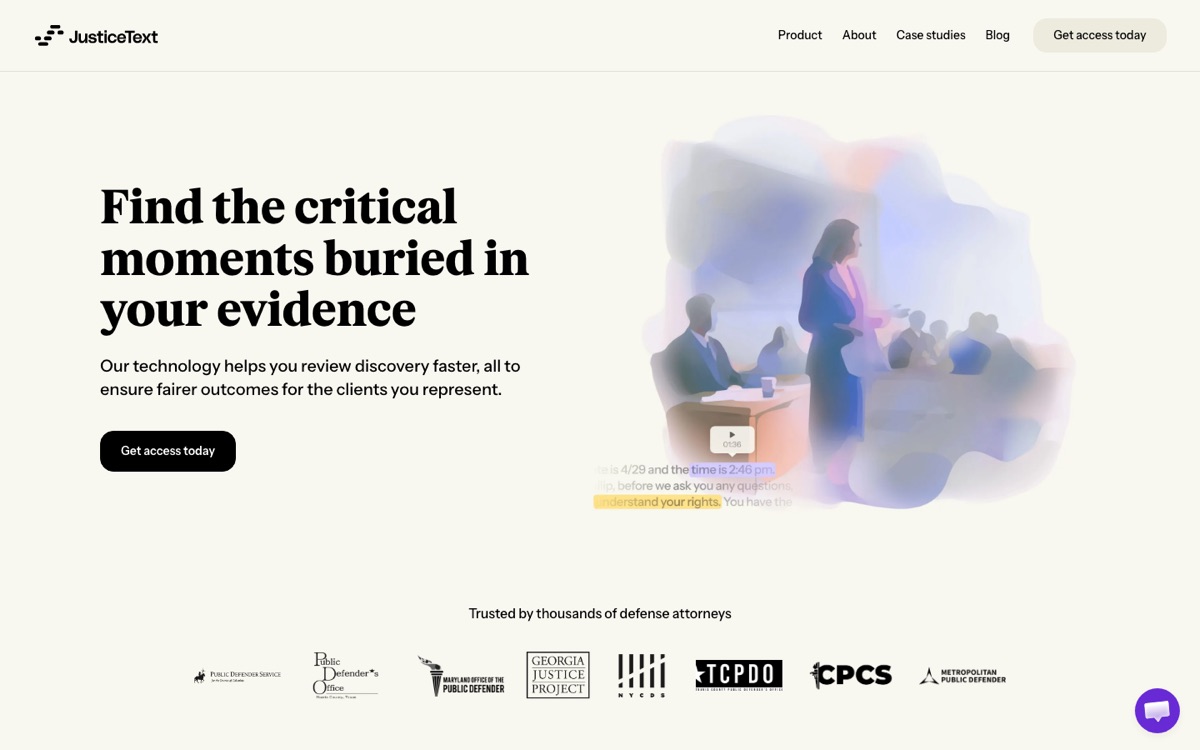 JusticeTextDiscovery review for defense teams
|
Public defenders and defense teams | Custom | Defense-oriented evidence handling |
| 09 | 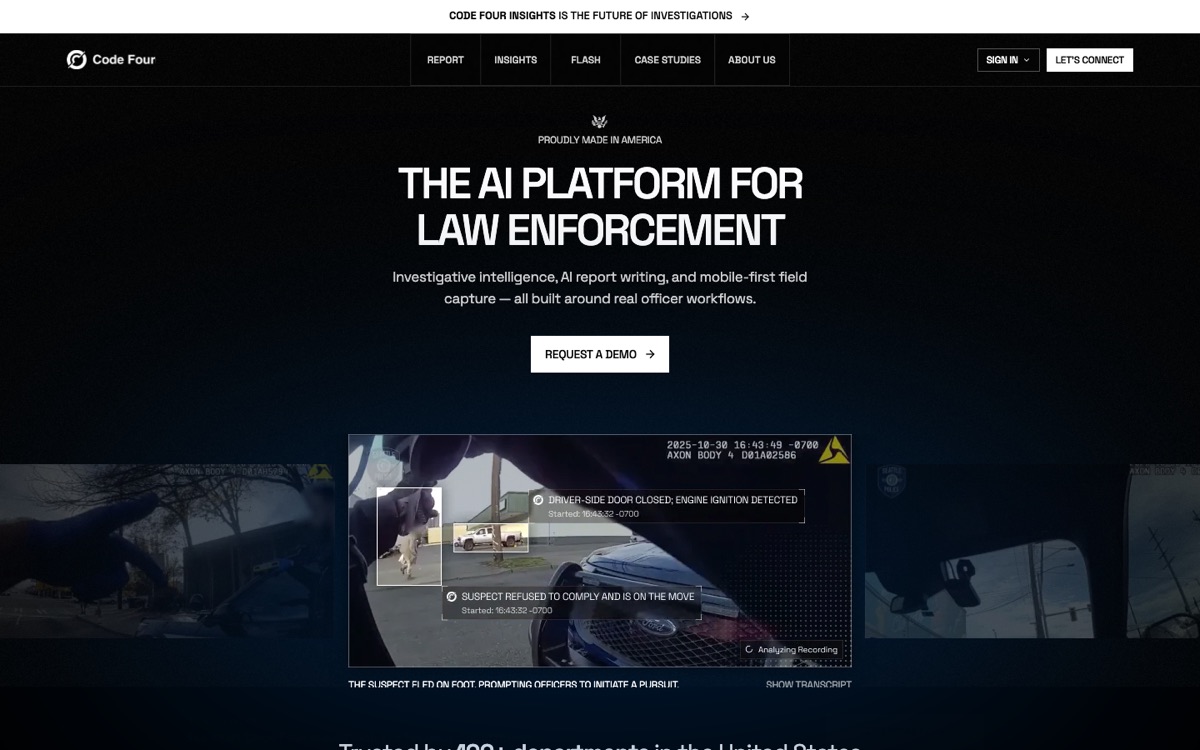 Code FourReport-first LE AI platform
|
Agencies wanting an all-in-one LE AI platform | Custom | Positions for law enforcement |
| 10 |  PatrolScribeForensic transcription as a service
|
Outsourced forensic transcription | Custom | Boutique service |
Pricing and pilot terms verified June 2026.
Good fit for report-ready BWC workflows from the cameras you already run.
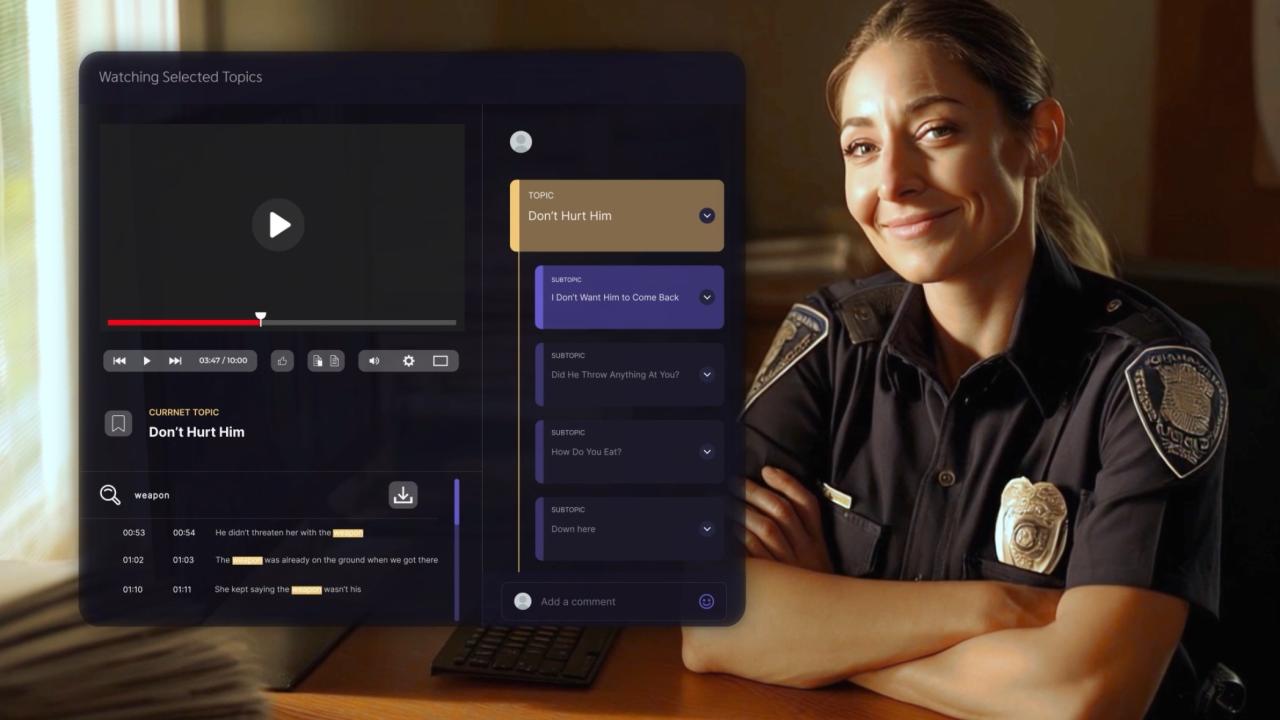
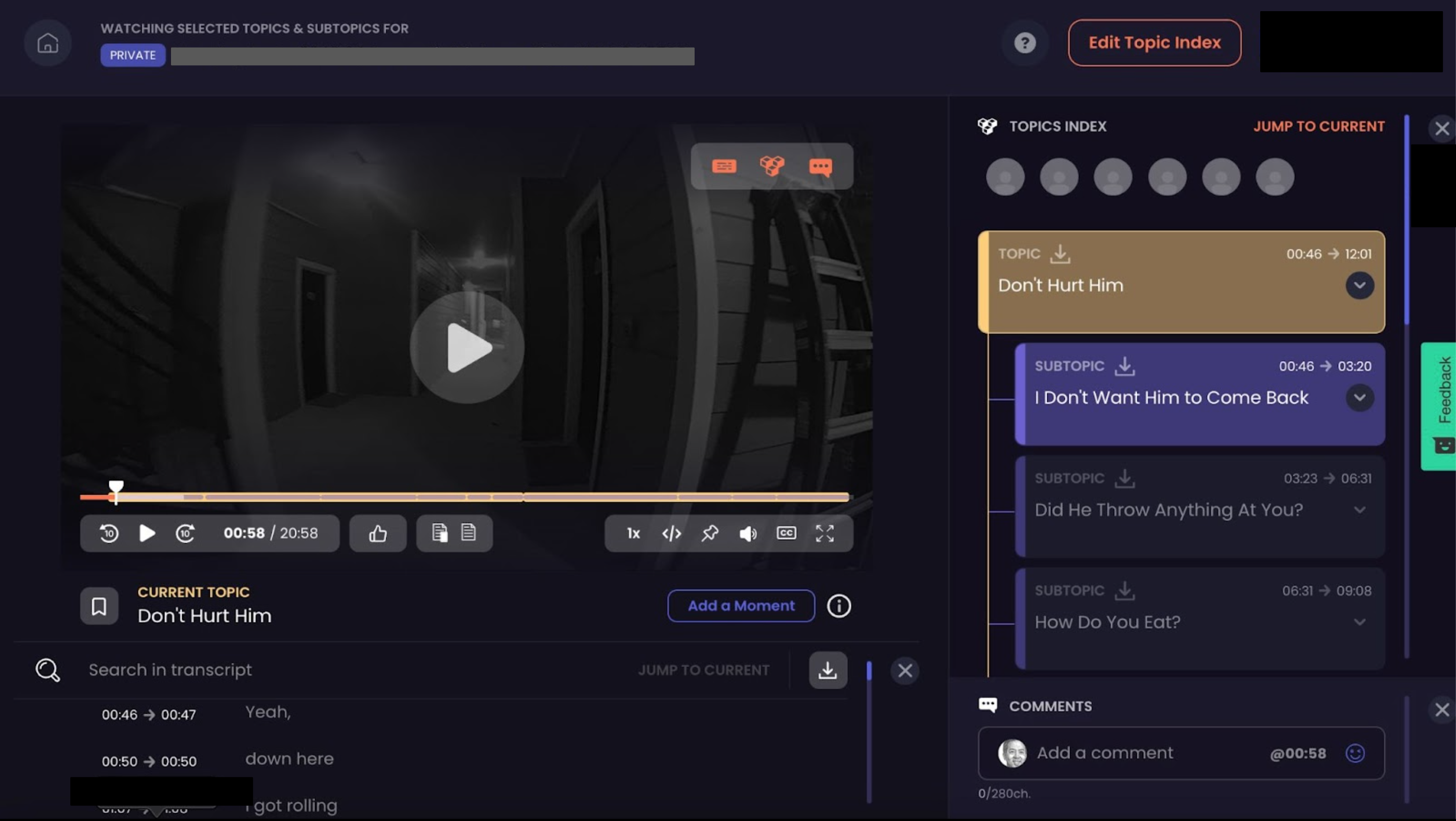
What it is: CLIPr is an AI for law enforcement bodycam-to-report automation platform that goes past raw transcripts. It turns BWC and dashcam audio into AI-assisted report drafts that officers review, edit, and own before the final moves into the RMS.
For this category, the fit is simple: report-ready output from cameras you already run. It is camera-agnostic, with security and data-handling terms available to review during procurement, and the free 30 to 90 day pilot tests the workflow before any contract.
The CLIPr workflow
The problem it targets is scale. CLIPr's homepage cites 1.2M+ hours of BWC footage recorded every day in the US, with 50%+ of officers' time spent drafting reports manually or skimming video.
Heads up: CLIPr requires an intentional workflow shift for officers who are used to typing traditional narratives from scratch.
Drafts still require officer review and editing, and time savings depend on adoption of the review-and-edit model and the quality of the source audio.
Pricing: Searchable Audio is $0.105/min and Searchable Video is $0.21/min; larger deployments can be utilization-scoped, and a free 30 to 90 day pilot is available with no credit card.
Good fit for: Small departments piloting quickly, plus larger city, county, sheriff, state, and sovereign agencies that want flexible "AI: Your Way" deployment across modern cloud, private, or hybrid architectures.
Good fit for agencies already standardized on Axon Evidence.
What it is: Axon Auto-Transcribe is the transcription layer built into Axon Evidence, generating transcripts directly on evidence items from Axon body cameras and other recordings.
Pricing: Sold as an add-on within Axon's bundle structure; the unlimited version is included in OSP7+ Premium. No standalone public price.
It is an ecosystem feature, not a standalone product. If your cameras or DEMS are not Axon, this option may not fit.
Good fit for: Agencies already on Axon Evidence, especially those on or moving to OSP7+ Premium, that want transcripts without introducing a new vendor.
Good fit for Motorola WatchGuard and CommandCentral stacks.
What it is: Assisted Transcription is Motorola's automated transcription capability inside CommandCentral Evidence, its digital evidence management system.
Pricing: Custom. Transcription is positioned as part of the CommandCentral Evidence offering rather than priced separately in public materials.
Public documentation provides less detail than some buyers may want. Expect to confirm workflow, export, security, and pricing details through the sales process.
Good fit for: Agencies running WatchGuard in-car or body cameras with CommandCentral Evidence that want transcription inside their existing DEMS contract.
Good fit for agencies that want automated drafts with a human QA pathway.
What it is: FirstDraft is VIQ Solutions' automated transcription product, sitting on top of a company with a long history in evidence-grade law enforcement transcription.
Pricing: Custom. No public per-minute or license pricing for FirstDraft.
It is a transcription and documentation company, not a DEMS. Plan the export path into your evidence and records systems before piloting.
Good fit for: Mid-size and larger agencies where some transcripts (major cases, interviews) justify human verification on top of AI drafts.
Good fit for multi-language transcription and redaction at scale.
What it is: Veritone applies its aiWARE platform to state and local government workloads, combining machine transcription engines with Veritone Redact for public-release workflows.
Pricing: Custom.
aiWARE is a platform, and platforms bring implementation work. Smaller agencies should verify that the scope matches their staff capacity and transcription volume.
Good fit for: Larger agencies, counties, and prosecutor-adjacent teams that need translation, redaction, and transcription volume in one contract.
Teams mapping the wider investigation stack can start with this guide to detective case management software.
Good fit for in-house redaction teams that want transcription in the same UI.
What it is: CaseGuard Studio is a desktop suite known for redaction that also handles transcription and translation for law enforcement video and audio.
Pricing: Custom, collected via quote.
It is a records-unit tool, not a report-writing workflow for patrol. Officers do not get draft narratives out of it.
Good fit for: Agencies with a dedicated records or redaction team processing a steady FOIA queue who want transcription as a bundled capability.
Good fit for pay-as-you-go AI or human transcripts.
What it is: Rev is a general-purpose transcription service with investigative and legal positioning, offering both AI and human-made transcripts on demand.
Pricing: $0.25/min AI, $1.99/min human, per Rev's published pricing. Subscriptions available. Source: Rev pricing page, as published by the vendor, last checked July 2, 2026.
No DEMS or RMS integration. Agencies should document how files leave the evidence environment, where they are processed, and how the chain-of-custody record is maintained.
Good fit for: Small agencies or units with occasional transcription needs and a policy answer for sending audio to a third-party service.
Good fit for public defenders and defense teams reviewing BWC at volume.
What it is: JusticeText is transcription and video-review software built for the defense side, turning bodycam footage, interrogation video, and jail calls into searchable, annotatable transcripts.
Pricing: Custom.
It is defense-oriented. Police agencies evaluating report-writing workflows should verify whether the product matches patrol documentation needs.
Good fit for: Public defender offices and defense firms processing high volumes of BWC discovery who need search and annotation, not report drafting.
Good fit for agencies that want an all-in-one LE AI platform.
What it is: Code Four is a law-enforcement AI platform whose positioning centers on generating ready-to-file narrative reports from bodycam footage.
Pricing: Custom.
Public documentation on integrations, security posture, and pricing is limited. Expect to build your BWC-TRUST score through demos and direct questions rather than published evidence.
Good fit for: Agencies open to a newer vendor and wanting a single platform spanning transcription and report generation, with a normal procurement review to work through.
Good fit for boutique forensic transcription services.
What it is: PatrolScribe is a forensic transcription provider producing summaries and searchable transcripts as a service rather than a self-serve platform.
Pricing: Custom.
As with any external service, your audio leaves the building. Ask how the service documents transfer, retention, deletion, and chain-of-custody handoffs.
Good fit for: Agencies or legal teams with episodic, high-stakes transcription needs (major cases, complex multi-speaker recordings) rather than daily patrol volume.
Run your shortlist through BWC-TRUST, weight the dimensions for your situation, and the answer usually surfaces on its own. Three worked archetypes show how the weighting changes the outcome.
Axon Auto-Transcribe scores near the ceiling on R because transcripts never leave Evidence.com, and the OSP7+ Premium inclusion makes the T (cost) score strong.
If the actual goal is report drafts rather than transcripts, run a CLIPr pilot alongside: it reads Axon footage without replacing anything.
Weight the first T (transcript quality, specifically translation) and S (compliance posture).
Veritone's 60+ language coverage and CaseGuard's translation-inside-redaction both score well; Veritone fits bigger volume, CaseGuard fits an in-house records team.
Weight transcript quality and R, where R means fit with discovery review rather than an RMS. JusticeText is usually the relevant comparison point because discovery review is its core workflow.
The quick version:
If report automation is the direction you are leaning, the deeper guide to the AI police report generator category breaks down how draft-generation tools differ from plain transcription.
Most failed deployments fail after the purchase, not before it. The recurring mistakes:
One scoping note: transcription is not the same as bodycam analytics. Platforms like Truleo center on analyzing officer language and professionalism rather than producing report-ready transcripts.
If analytics is the category you are actually shopping, the Truleo alternatives guide covers it.
The recording itself remains the primary evidentiary record; transcripts generally function as aids for review, preparation, and reference.
Admissibility rules vary by jurisdiction and judge, so treat transcripts as working documents and let counsel decide how they are used in proceedings.
For a closer look at transcription in legal settings, see this guide to legal transcription software.
Treat CJIS as a posture question, not a checkbox. Look for vendors built around CJIS Security Policy alignment, review their security documentation, and check requirements with your state CJIS Systems Agency, IT, and counsel.
A badge is a starting point; the documentation behind it tells the fuller story.
It depends on which of the 10 tools you pick. Axon and Motorola transcribe natively inside their own evidence platforms. Most others, including CLIPr, work camera-agnostically and move output into your RMS through export or copy-out workflows.
Confirm the exact path during a pilot, not after signature.
Rev and CLIPr both publish per-minute reference rates: Rev lists $0.25 per minute for AI and $1.99 per minute for human transcription, while CLIPr lists $0.105 per minute for Searchable Audio and $0.21 per minute for Searchable Video. Both are per-minute models rather than the per-user or utilization-based contracts common elsewhere in the category (source: each vendor's pricing page, as published by the vendor, last checked July 2, 2026).
Axon includes unlimited transcription in OSP7+ Premium bundles, and the rest use custom or utilization-based pricing.
If budget is the blocker, agencies can explore funding and grants for police reporting software before waiting on the next budget cycle.
The right pick is rarely the highest-ranked tool in the abstract. It is the tool that scores highest on the BWC-TRUST dimensions your agency actually weights: stack fit for Axon and Motorola shops, translation and redaction for diverse jurisdictions.
Discovery review for defense teams, and report drafting for agencies trying to put officers back in the field.
Small departments still matter in this category.
Departments with fewer than 50 sworn officers make up 88% of US local police departments (table 3 of BJS’s Local Police Departments, 2016: Personnel), and they rarely have spare budget or IT staff for a heavy platform.
Larger city, county, state, and sovereign agencies should score the same tools on architecture control, utilization, language coverage, sovereign deployment controls, and integration path.
For those agencies, a practical next step is a pilot with footage you already have.
The 14-day MDT pilot for small departments requires no dock and no new hardware: drag and drop audio or video from your existing BWC evidence platform and score the drafts against your own reports.
CLIPr turns BodyCam and DashCam audio into AI-assisted police report drafts that officers review, edit, and copy into their RMS.
The platform displays CJIS Security Policy-aware and SOC 2 architecture signals, holds 6 US patents, and provides ownership, retention, and deletion terms for review during procurement.
Run CLIPr with your own bodycam footage. Free 30 to 90 day pilot for up to 50 officers, no credit card required, subject to approval.