CLIPr Proudly Sponsors SRLEEA Conference in Orlando
At SRLEEA, FBI Director Patel called AI essential for agencies of every size. See how CLIPr is helping small and rural departments do more with less.


Choosing a police records management system (RMS) is a records-lifecycle decision, not a feature contest. This guide compares 10 current options against that lifecycle, so you match one to your agency.
The right RMS shifts on five binding constraints:
Our pick is a process: settle your state reporting path and installed stack first, then run the three or four that fit the worksheet below.
A police records management system is the agency's primary system of record for law-enforcement records across creation, review, approval, search, reporting, retention, and disposition.
Neighboring systems, including CAD, a digital evidence management system (DEMS), a jail management system (JMS), case management, and report drafting, connect to it but are not interchangeable with it, and the next section maps each one.
The five fit lenses above do most of the shortlisting work, so settle them before booking a demo or drafting a request for information (RFI) or request for proposal (RFP).
Start with the systems that can document your required state reporting, records governance, named integrations, deployment model, and migration path. Then test complete agency scenarios and put support, pricing, data export, and exit terms in the proposal and contract. A longer feature list is not a substitute for lifecycle fit.
The comparison table below summarizes public evidence for all 10 options, and the lifecycle worksheet turns every unknown into a demo, reference, or contract question.
The working definition comes from the Standard Functional Specifications for Law Enforcement Records Management Systems, Version IV (May 2025, International Association of Chiefs of Police (IACP) and the IJIS Institute), which describes the RMS as the system that carries a record end to end, from incident creation through disposition.
It is functional guidance for evaluation, not a certification.
Before comparing products, place each system in the broader law enforcement software categories it actually belongs to; shortlisting the wrong category leads to the wrong contract.
| Category | Primary job | Relationship to RMS |
|---|---|---|
| RMS | System of record for law-enforcement records across creation, review, reporting, retrieval, retention, and disposition | Core category in this article |
| CAD | Call intake, dispatch, unit status, and response operations | Feeds call and response data into records workflows |
| DEMS (digital evidence management system) | Digital-evidence ingest, storage, integrity, access, review, retention, and sharing | Links evidence and cases without becoming the RMS; see digital evidence management systems |
| JMS (jail management system) | Booking, custody, housing, and jail operations | Exchanges arrest, booking, person, and disposition data where configured |
| Case management | Investigative tasks, relationships, collaboration, and specialized case workflow | Can be native to or layered beside an RMS; see detective case management software |
| Report drafting | Produces a reviewable draft from notes, audio, video, or forms | Upstream assistance; the approved police report still belongs in the RMS |
| Scheduling | Shifts, bidding, overtime, court, and staffing | Separate workforce category |
No interface in this table should be assumed native, included, or bidirectional. Each connection is a per-deployment fact to verify.
Every product in this article passed the same five-part category screen:
CLIPr is not scored on this RMS-only screen: it is an upstream drafting layer, not a system of record.
All 10 RMS products run on the same axes: records lifecycle, Uniform Crime Reporting (UCR) and NIBRS state reporting, review and approval, mobile and offline behavior, audit and export, named interfaces, migration and cutover, security, and pricing.
The worksheet below carries the evidence for each.
Product facts come from each vendor's current official materials.
Evaluation criteria come from the IACP/IJIS Version IV specification, the Federal Bureau of Investigation (FBI) 2025.0 NIBRS technical specification (June 2025), and the FBI Criminal Justice Information Services (CJIS) Security Policy, version 6.1 (June 2026).
These define what to evaluate, not who is certified; NIBRS conformance does not establish state acceptance.
Numbering supports navigation and matches the profiles below. The 10 options are grouped by procurement context and alphabetized within each group. They are not ranked by quality.
| # | RMS | Good fit to investigate when | Deployment and field evidence | Reporting evidence | Named ecosystem or interface evidence | Pricing status |
|---|---|---|---|---|---|---|
CLIPrComplementary drafting layer
|
CLIPr turns supported body-camera audio into AI-assisted first-draft reports for officer review before RMS entry. The officer reviews, edits, and owns the report, and the agency verifies its exact input and handoff workflow during the pilot.
Request a 30-Day Agency Pilot
|
|||||
| 01 |  CentralSquare RecordsEnterprise and connected suite
|
Already using or evaluating CentralSquare public-safety products | Confirm product line and deployment; mobile described, offline scope not established | Confirm state and NIBRS package | CentralSquare portfolio: CAD, mobile, jail | Public amount not located |
| 02 |  Mark43 RMSEnterprise and connected suite
|
Cloud-native records and case workflow is a primary constraint | Cloud-native per Mark43; confirm field and offline scope | Confirm state and NIBRS package | Mark43 platform modules | Public amount not located |
| 03 |  Motorola CommandCentral RMSEnterprise and connected suite
|
Evaluating a Motorola cloud records path, or Flex/PremierOne dependencies | Cloud-native per Motorola; field workflows with offline sync (incident, citation, crash) | Confirm state and NIBRS package | CommandCentral CAD and evidence; legacy path described | Public amount not located |
| 04 |  Tyler Enterprise Law Enforcement RecordsEnterprise and connected suite
|
Using or evaluating Tyler Enterprise Public Safety | Confirm hosting and architecture; field reporting described, offline scope not established | Confirm state and NIBRS package | Tyler CAD and mobile products | Public amount not located |
| 05 |  Versaterm RMSEnterprise and connected suite
|
Multi-jurisdiction or mid-to-large workflows and mobile records | Confirm proposed deployment; connected and offline mobile data entry described | UCR2 and NIBRS described; state acceptance requires verification | CAD, JMS, NCIC, Nlets, and state-network connections | Texas Department of Information Resources (DIR) index: 5% discount and a sworn-count unit; dollar total not located |
| 06 |  CivicRMSConfigurable and agency-hosted
|
Evaluating the CivicEye CAD, JMS, records, and evidence stack | Cloud positioning vendor-stated; confirm scope, offline scope not established | NIBRS validation described; state acceptance requires verification | CivicEye CAD, JMS, evidence modules | Public amount not located |
| 07 |  CODY Pathfinder RMSConfigurable and agency-hosted
|
Configurable single or multi-agency records with browser/mobile access | Web or cloud positioning; iOS, Android, Windows access, offline scope not established | NIBRS validation and state/federal reports described | Property/evidence and configurable workflow in Pathfinder | Public amount not located |
| 08 | 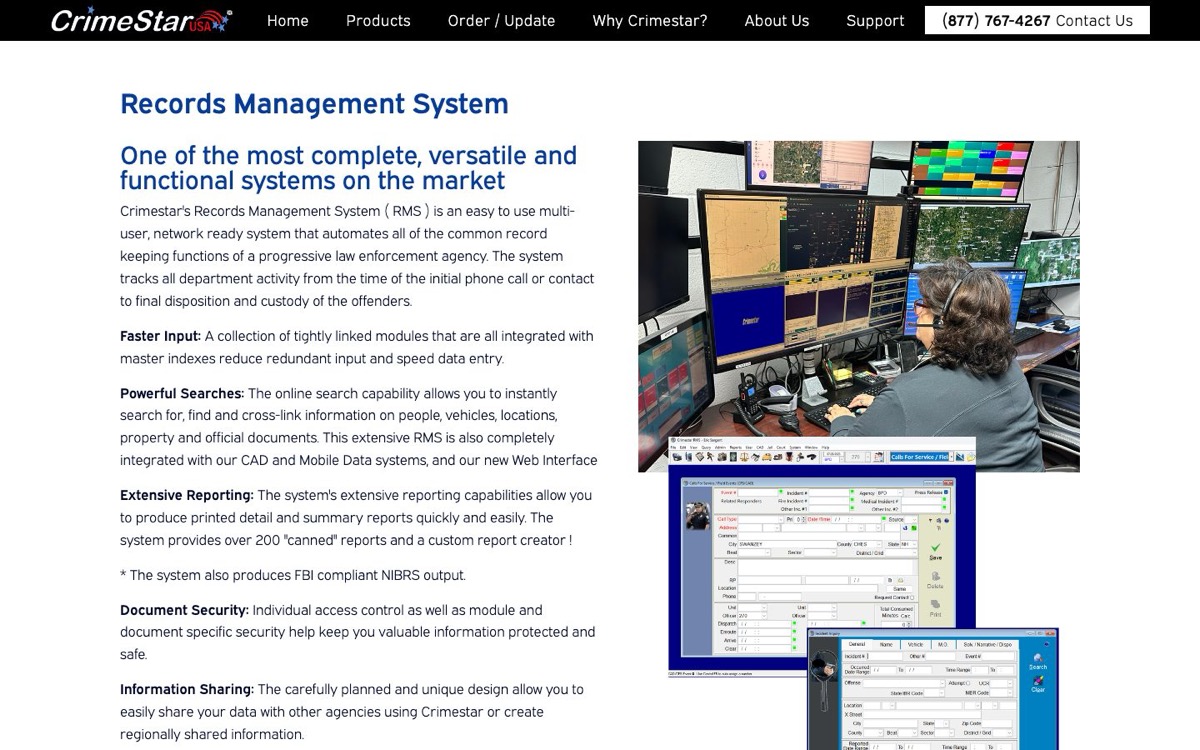 CrimeStar RMSConfigurable and agency-hosted
|
Published concurrent-user licensing and an agency-managed database | Professional and Enterprise (SQL Server) editions; separate laptop sync and mobile products, test the workflow | 2025 NIBRS XML updates in release history; state acceptance requires verification | Separate CAD, web, mobile, state-interface products | $3,300 per RMS user license with first-year support, then $400 annual; add-ons separate |
| 09 |  Enterpol RMSConfigurable and agency-hosted
|
Small or midsize agency evaluating an integrated records suite | Confirm proposed deployment; offline scope not established | UCR, NIBRS, BIA, Clery, state support described; exact package requires verification | Court, mapping, ticket, CAD, JMS interfaces listed | Public amount not located |
| 10 |  Optimum SWIFTPROTECTConfigurable and agency-hosted
|
Agency-hosted or Azure Government flexibility is a primary requirement | Agency-hosted or Microsoft Azure Government; mobile access described, offline scope not established | NIBRS support described; state acceptance requires verification | Records, case, booking, intelligence, property modules | Public amount not located |
Grouped by procurement context, alphabetized within each group, not ranked by quality. CLIPr, shown in the first row, is a complementary drafting layer, not one of the 10 ranked RMS options.
Every cell is a starting point for the demo and the proposal, not a settled fact: a catalog mention does not establish included licensing, interface direction, supported versions, or a successful deployment at an agency like yours.
Where a cell says "not established publicly," that is a documentation gap to resolve, not a product defect.
This worksheet is a neutral agency tool: it does not score vendors, and your team sets the priorities and records the evidence. For every requirement, mark one evidence state:
These are maturity states, not points; do not total them into a product score. Before comparing convenience features, define your baseline gates:
A gate you have not documented yet means "requires review." Do not label a product disqualified unless your exact agency requirement and an evaluated proposal support that decision.
| Lifecycle area | Agency-owned test | Evidence to retain |
|---|---|---|
| Incident creation | Enter a representative incident from first contact through supervisor approval | Screens, workflow map, roles, required fields, validation results |
| State and NIBRS reporting | Validate current agency offense, arrest, property, victim, and error-correction scenarios against the state repository | Version, state acceptance process, validation output, error workflow |
| Case lifecycle | Add supplements, assignments, relationships, status changes, referrals, and disposition | Demo record, audit entries, case-status map |
| Field and offline | Complete a field workflow with connectivity loss, conflict, retry, and synchronization | Supported devices, offline scope, conflict behavior, sync logs |
| Review and approval | Route a rejected, corrected, reassigned, and approved report | Version history, permissions, notifications, sign-off record |
| Search and disclosure | Find a person, vehicle, location, report, and related case; export an approved records response | Query fields, result logic, redaction or disclosure handoff, export sample |
| Retention and expungement | Apply a test schedule, hold, seal, expungement, purge, and exception | Rules, approvals, logs, proof of action, recovery behavior |
| CAD, JMS, DEMS, prosecutor | Trace one record across each required named system | Interface direction, objects, frequency, versions, errors, fees |
| Migration | Convert representative clean, duplicate, incomplete, sealed, and linked legacy records | Mapping, exceptions, reconciliation totals, acceptance criteria |
| Cutover and continuity | Rehearse freeze, delta load, rollback, outage, and manual continuity | Runbook, owners, recovery time objective (RTO) and recovery point objective (RPO), support escalation |
| Support and change | Submit a test issue and review release, maintenance, training, and upgrade process | SLA, hours, severity definitions, release notice, training plan |
| Exit | Export records, attachments, metadata, relationships, audit, and configuration in documented formats | Sample export, schema, fees, timing, deletion confirmation, assistance terms |
These five products sell records management inside a broader public-safety portfolio or as a cloud platform play.
They tend to fit agencies whose shortlist starts with an installed suite, a platform standard, or multi-jurisdiction scale. Listed alphabetically, not ranked.
Law-enforcement RMS within a broader public-safety portfolio.
CentralSquare documents records access and reporting plus connections across its CAD, mobile, jail, and public-safety portfolio. Its public-safety suite carries mixed user reviews on G2, where reviewers praise ease of search and raise questions about long-term product support.
CentralSquare One is the vendor's broader unified platform; it is a separate proposition, and suite-level claims do not transfer to every records deployment.
Records-system governance has drawn public scrutiny worth reading before a demo: syndicated NBC and KPRC coverage reported that Houston marked more than 260,000 cases "suspended" in its CentralSquare records system, and the city has contracted a replacement while extending the existing contract through late 2026.
Treat it as a prompt to probe default case-lifecycle configuration and records governance directly.
Pricing status: Public amount not located.
Ask which named products, not which brand, appear on the order form. Run the exact product line, deployment, state reporting package, migration plan, and data exit through the lifecycle worksheet above.
Cloud-native law-enforcement RMS.
According to Mark43's official RMS page, the platform covers incident reporting, case management, property and evidence, analytics, and 24/7 support. Offline behavior, retention and expungement detail, and export formats were not established publicly.
Independent trade coverage backs a real cloud-adoption curve: police1.com has profiled Mark43 deployments, including a U.S. Department of the Interior rollout across roughly 3,000 sworn officers and 200-plus agencies in the U.S. and U.K.
Formal review volume is thin, with a single 4.0 rating on Capterra, so the deployment record is the stronger buyer signal.
Pricing status: Public amount not located.
A cloud-native architecture claim still needs deployment-specific security documentation. Confirm state acceptance, field and offline behavior, retention and expungement, data exit, and package pricing against the worksheet.
Cloud-native RMS in the Motorola CommandCentral portfolio.
Motorola documents field incident, citation, and crash reporting with offline synchronization, CAD data reuse, case workflow, and evidence connections. Its April 2026 launch announcement describes CommandCentral RMS as a unified records and case platform with compatibility paths for existing Flex and PremierOne customers.
Independent coverage on officer.com (April 2026) named Las Vegas Metropolitan PD as an early adopter and cited an AI-assisted redaction case that cut processing from 35 hours to about 1 hour.
Separate the new CommandCentral RMS from the legacy Spillman Flex track record when you compare paths: an NBC News investigation documented software errors across at least three states tied to Spillman, the records product Motorola acquired in 2016, including a lost report and a crash during 911 calls.
That history sits on the legacy path, not on CommandCentral RMS.
Whichever Motorola records path an agency lands on, the officer still writes the narrative. CLIPr drafts that narrative from bodycam and dashcam audio upstream, so the report reaches the RMS already reviewed and approved by the officer.
Pricing status: Public amount not located.
A compatibility statement is not a turnkey migration; ask what parity your current Flex or PremierOne modules keep, and reverify current product naming at contract time. Take module scope, DEMS and CAD interfaces, and cutover through the worksheet.
Law-enforcement RMS in Tyler Enterprise Public Safety.
Tyler Technologies documents records for cases, incidents, people, vehicles, property, and citations; field reporting; configurable fields; and approval workflows that add approved reports to the records database.
On aggregator reviews, Tyler Enterprise Public Safety scores 4.0 on G2, where reviewers value data-sharing but call it one of the more expensive options and caution buyers not to assume a module is included.
The public-safety delivery record also carries documented friction: reporting on a Sacramento regional dispatch lawsuit and a San Jose court-ticketing glitch describe deployments running behind schedule or over budget.
Most involve CAD or court modules in the same New World and Tyler suite rather than the RMS module specifically, so scope your references to the exact product.
Pricing status: Public amount not located.
Suite alignment is an advantage worth verifying at the named-product and version level, not assuming. Confirm hosting, offline scope, state reporting, and database and attachment conversion against the worksheet.
Multi-jurisdiction law-enforcement RMS.
According to Versaterm, the RMS provides role-based records workflow, connected or offline mobile data entry, multi-jurisdiction use, and UCR2 or NIBRS-oriented reporting. A current Texas DIR cooperative contract (DIR-CPO-5266) covers Versaterm RMS plus conversion, configuration, training, and related services.
On the deployment side, Houston selected Versaterm to replace its prior records system for $31 million in 2023, though syndicated NBC and KPRC coverage reports the go-live has slipped repeatedly into 2026.
Treat a flagship migration timeline as a cutover risk to probe with similar-agency references at your scale.
Pricing status: The 2026 Texas DIR pricing index lists a 5 percent discount and a sworn-count subscription unit for Versaterm RMS. No public dollar total is visible; an agency quote and statement of work are still required.
Treat the cooperative index as a procurement reference, not a quote. Confirm the exact state interface and accepted version, deployment, conversion scope, and your agency-specific total against the worksheet.
These five products fit agencies that weight configurability, published licensing, agency-hosted control, or a small-agency footprint over suite scale. Same card template, same evidence standard. Listed alphabetically, not ranked.
RMS in the CivicEye public-safety platform.
Per CivicEye's product materials, CivicRMS covers records access, evidence, NIBRS validation, CAD and JMS integration, platform scale, and 24/7/365 support. Offline behavior, export, retention detail, and implementation terms were not established publicly.
Independent small-agency reviews are limited but positive: CivicEye holds 4.4 on GetApp and 4.4 on SoftwareAdvice (8 reviews each), with reviewers repeatedly praising customer service and one noting it is "not user friendly to start."
For a small agency weighing that onboarding curve, report writing is often the real time sink. CLIPr drafts the narrative from bodycam audio before it enters the RMS, so officers spend less time typing and more time on patrol.
Pricing status: Public amount not located.
Ask for deployment-specific security documentation rather than repeating the page's compliance labels. Confirm state acceptance, offline behavior, module boundaries, and export against the worksheet.
Configurable law-enforcement RMS.
CODY Systems documents web or cloud access on iOS, Android, and Windows; single or multi-agency use; property and evidence chain workflows; NIBRS validation; dashboards; and state or federal reporting.
Independent trade validation exists even without aggregator ratings: Police Chief Magazine (IACP, September 2024) profiled PathfinderRMS as CODY's next-generation cloud RMS, noting 800-plus agencies across 18 states with CJIS Security Policy-aligned handling and NIBRS reporting support, and the launch was carried on PR Newswire.
Pricing status: Public amount not located.
Configurability is a strength that also means your configuration choices need their own acceptance testing. Confirm offline behavior, state acceptance, hosting, and retention and expungement against the worksheet.
Licensed RMS with Professional and Enterprise database editions.
CrimeStar documents multi-user RMS editions on a desktop database (Professional) or Microsoft SQL Server (Enterprise), separate CAD, web, mobile, and state-interface products, an active release history including 2025 NIBRS XML updates, and published pricing.
No independent review-site ratings were located for CrimeStar, so its published pricing and release history are the clearest public signals; weigh them against the demo and reference evidence you gather directly.
Pricing status: Effective 2025-09-01, CrimeStar's official order page lists $3,300 for one RMS user license with first-year support, composed of a $2,900 one-time license and $400 support, with $400 annual support after year one. Add-ons are priced separately.
Before comparing this license price to subscription totals, model SQL Server and other infrastructure, backups, add-ons, state interfaces, and support at your scale. A release log shows maintenance activity, not state acceptance or agency fit.
Law-enforcement RMS marketed to small and midsize agencies.
Per Enterpol's product materials, the RMS provides records modules with UCR, NIBRS, Bureau of Indian Affairs (BIA), Clery Act, and state reporting support, plus a published interface catalog naming court, crime mapping, ticket-writing, CAD, and JMS connections.
No independent review-site ratings, analyst reports, or news coverage were located for Enterpol, so its vendor materials are the only public signal; weigh them against the demo and reference evidence you gather directly.
Because CLIPr is designed as a separate drafting layer, a small or midsize agency can evaluate it beside Enterpol without assuming a direct interface. The officer reviews the draft, and the agency verifies how the approved report enters its system of record during the pilot.
Pricing status: Public amount not located.
An interface catalog lists what exists somewhere, not what is licensed, configured, and supported in your deployment. Confirm your exact state package, offline behavior, and interface direction and fees against the worksheet.
Web-based public-safety RMS.
Optimum Technology documents incident, case, booking, intelligence, and property modules, mobile access, NIBRS-oriented reporting, and two deployment patterns: agency-hosted or Microsoft Azure Government.
Independent reviews were not located; the clearest neutral artifact is its Microsoft commercial-marketplace listing, which confirms availability and Microsoft-preferred status rather than user ratings.
Pricing status: Public amount not located.
Request the deployment-specific security package rather than repeating a compliance label. Confirm state acceptance, mobile and offline details, retention, and numeric pricing for your deployment pattern against the worksheet.
Start from the binding constraint, investigate products that document a fit, and let the lifecycle worksheet carry the evidence:
Two constraints usually decide the shortlist before any demo: the state reporting path and the installed stack. Resolve those first and the 10-product field typically narrows to three or four candidates worth a full lifecycle test.
Keep the lifecycle worksheet as the evidence record, then carry only these decision questions into the RFP:
A vendor that answers these in a priced proposal and contract schedule has done more for your risk posture than any feature list.
CLIPr publishes this guide, and it is not one of the 10 options above. It is an upstream drafting layer, not a system of record, and it was not scored in the comparison.
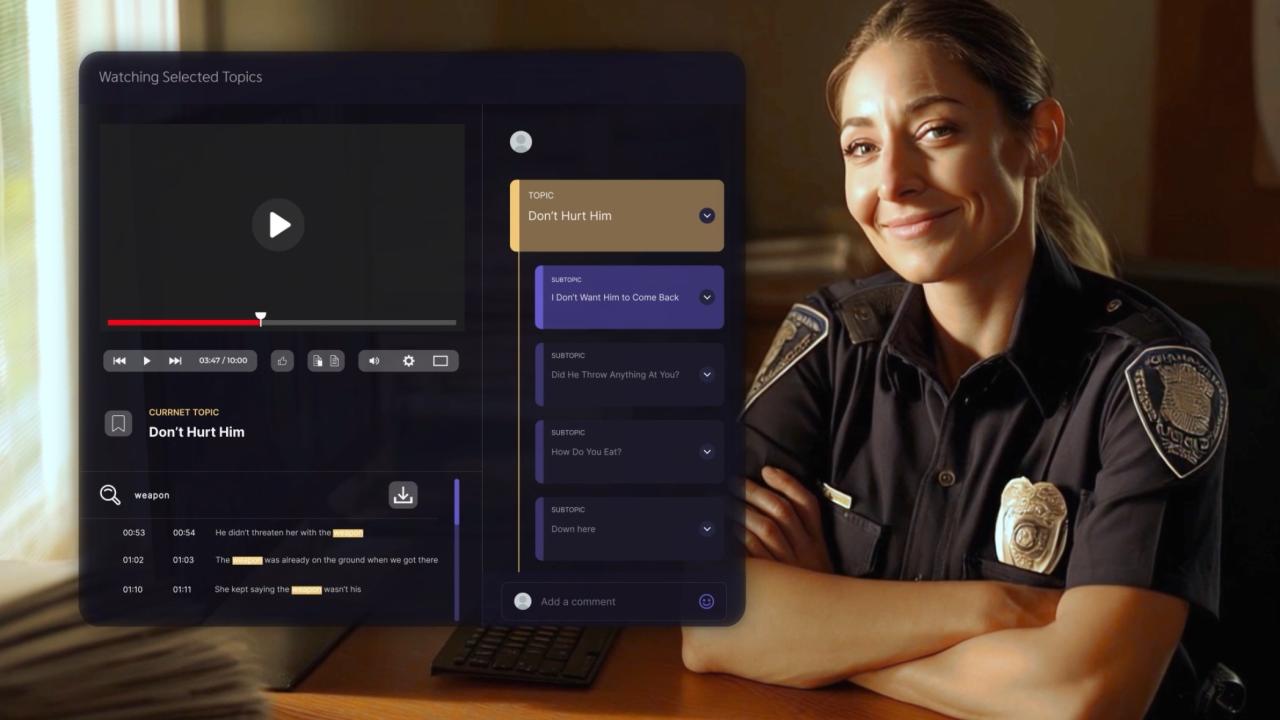
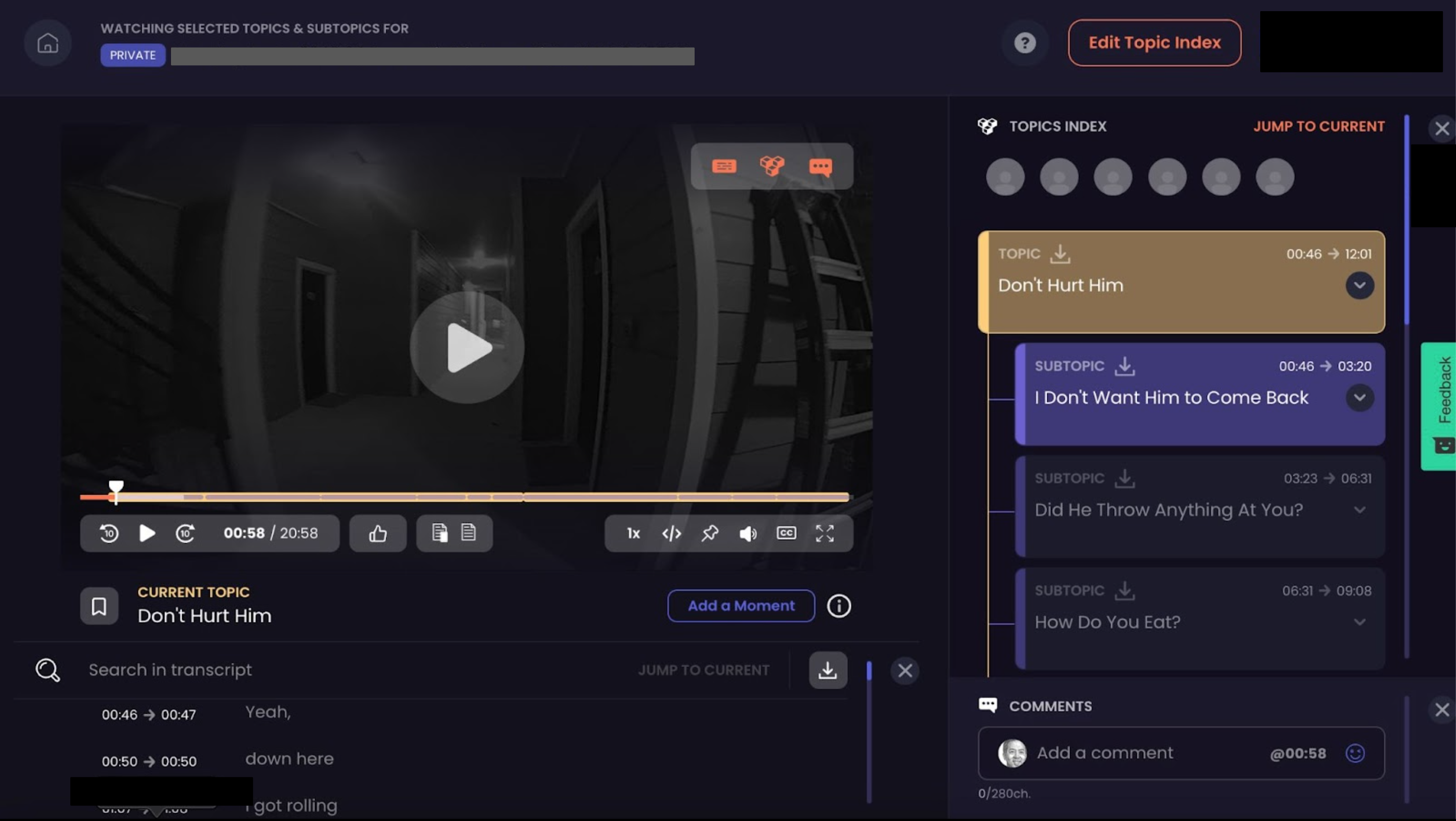
CLIPr turns bodycam and dashcam audio into a searchable transcript, a timestamped Question and Answer index, and an AI-assisted first-draft report the officer reviews, edits, and owns. The approved report then enters your RMS.
CLIPr is designed as a separate drafting layer: supported footage or field audio enters CLIPr, the officer reviews the draft, and the approved report follows the agency's verified RMS-entry process. CLIPr Mobile captures field audio on iOS and Android, and CLIPr's published reference rates are $0.105 per audio minute and $0.21 per video minute for an itemized comparison with RMS modules.
If your agency is mid-replacement on core records infrastructure, weigh an RMS-native drafting workflow inside that evaluation. The police report writing software guide covers that category on its own terms.
A police records management system (RMS) is the agency's system of record for law-enforcement records across creation, review, approval, search, reporting, retention, and disposition.
The IACP/IJIS Version IV specification (May 2025) describes the functional lifecycle, including state reporting, audit, sealing and expungement, and interfaces with CAD, jail, state, and court systems.
It is an evaluation framework, not a product certification.
CAD (computer-aided dispatch) runs live operations: call intake, dispatch, unit status, and response. The RMS owns the record afterward: reports, cases, property, arrests, retention, and disposition.
In most deployments CAD data feeds the RMS so officers do not re-key call details, but the interface direction, fields, and licensing are per-deployment facts to verify, not givens.
A digital evidence management system (DEMS) ingests, stores, and controls digital evidence files: video, audio, images, and documents, with integrity, access, retention, and sharing controls.
The RMS holds the written record and case data. The two link to each other where configured, but neither replaces the other, and evidence custody controls stay with the DEMS.
Not by itself.
NIBRS support means the product can produce incident-based submissions in line with the FBI specification, while each state repository has its own current package, validation rules, and acceptance process.
Verify the vendor's exact state package and version, ask for the state acceptance path, and validate your own offense and arrest scenarios during the demo.
Neither pattern is universally better; treat deployment as an agency constraint, not a preference.
Cloud fits agencies without database and infrastructure staffing, subject to security review and data terms. Agency-hosted fits agencies with a hosting mandate and the staff to run patching, backups, and upgrades.
Both patterns appear in this comparison, and both call for deployment-specific security documentation.
Nine of the 10 options reviewed here publish no public price; expect an agency-specific quote.
CrimeStar lists $3,300 for one RMS user license with first-year support, then $400 annual support, effective 2025-09-01, and Versaterm's Texas DIR index shows structure, not totals.
Budget the full TCO (total cost of ownership): licenses, hosting, interfaces, conversion, training, support, and exit.
The 10 products above are all current, credible records platforms for some agency profile. Which one fits yours depends on the records lifecycle, state reporting path, installed stack, deployment policy, migration capacity, procurement route, and exit terms you can secure in writing.
The worksheet above exists so that by the time you sign, nothing important is still resting on "public material reviewed."
The CLIPr Team writes about AI-assisted documentation for law enforcement.
CLIPr turns BodyCam and DashCam audio into AI-assisted first drafts of police reports that officers review, edit, and approve into their existing RMS, backed by a SOC 2 compliant architecture and a design that is CJIS Security Policy-aligned.
The RMS decision above runs on lifecycle evidence, and report drafting can pilot beside whichever system wins.
CLIPr turns bodycam and dashcam audio into a reviewable first draft that the officer reviews, edits, and owns, with the approved police report entered into your RMS.
30-day agency pilot for up to 50 officers, subject to approval. No credit card required.