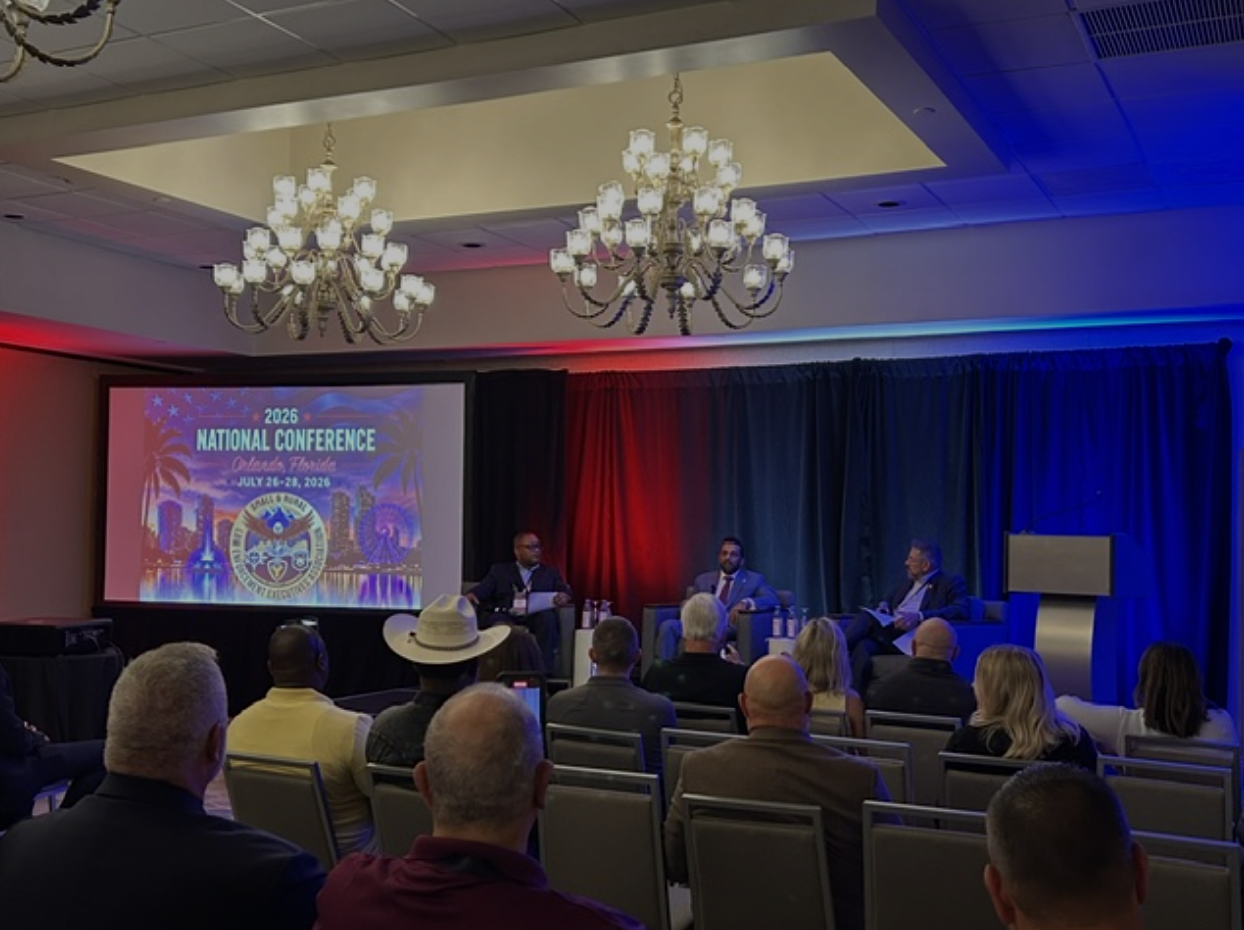
CLIPr Proudly Sponsors SRLEEA Conference in Orlando
At SRLEEA, FBI Director Patel called AI essential for agencies of every size. See how CLIPr is helping small and rural departments do more with less.



11 transcription platforms scored with the L-TRACE rubric across certification, legal exports, chain of custody, accuracy, security, and workflow fit, with sourced pricing for every tool.
If you run litigation support, manage a practice, or produce transcripts for a court reporting agency, speed and low cost are not enough. The legal questions start once a transcript is relied on.
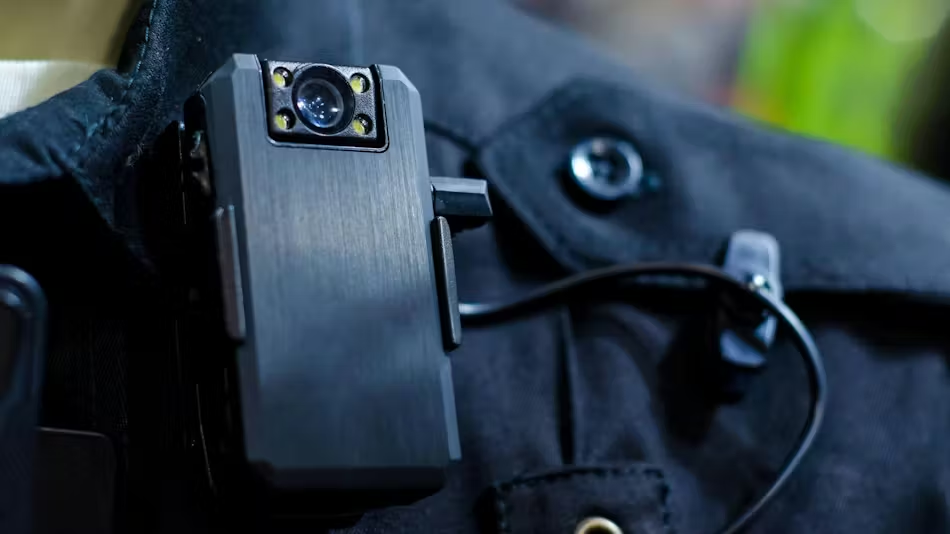
Many "best transcription software" lists rank meeting apps. Legal teams need certification paths, court-ready exports, and audit trails for challenges. They also underweight interviews, interview-room video, and bodycam footage, where the useful deliverable is a speaker-attributed, timestamped record checked against the source.
This guide evaluates 11 tools against the L-TRACE rubric. By the end, you should be able to shortlist 1 or 2 tools and explain the choice. CLIPr is one tool in the table, so the scoring states where it fits and where it does not.
Legal-ready is more than accurate text. A transcript that cannot be certified, exported correctly, or reviewed against the source recording may not be usable when the record is challenged.
L-TRACE scores each tool on six weighted criteria. The weights reflect issues that commonly create procurement or courtroom risk, not what looks good on a feature page.
One disclosure up front. Court-reporting buyers and digital-evidence buyers are two different lanes. A certified deposition producer and an investigative-evidence platform are rarely the same tool, so ranks in this guide are scoped to the buyer profile named in each row, not read as a single overall leaderboard. For a court-certified deposition or hearing transcript, criterion 1 is decisive and Verbit or VIQ Solutions lead. CLIPr is ranked first for the separate digital-evidence lane: bodycam, dashcam, and interview-room recordings where searchable, speaker-attributed records and first-draft reports matter more than certification.
Good looks like a documented route from AI draft to a human-reviewed or certified transcript inside the same workflow. Agencies and firms should verify any claim that AI output alone is ready for court use.
Good looks like deposition and court transcript conventions: page-line numbering, condensed and full-size layouts, certificate pages, and formats like ASCII, PTX, or LEF alongside PDF. Generic DOCX-only export may require extra formatting work.
Good looks like retained source audio linked to the final text, plus a way to show review history. Where a tool does not surface full edit, version, and access logs itself, teams can document review history in their own process.
Good looks like AI plus a human review layer, reliable speaker diarization, and timestamps. AI-only output can still score here if diarization and timecodes are strong, but review expectations should be clear.
Good looks like SOC 2 attestation, encryption, and data-control commitments. HIPAA eligibility matters only when protected health information appears in your recordings.
Good looks like clean handoff into the systems you already use: document management, case management, evidence platforms, or an API when you are building in-house.
Verbit scores well on criterion 1 because certified Final Transcripts are a core product, while its custom pricing requires a sales conversation.
VIQ Solutions scores well on criteria 2 and 3 because its pipeline was built for court transcript production, with procurement handled through a sales-led process.
This distinction shapes the shortlist, so define it before comparing tools.
AI draft
Machine-generated text. It is excellent for case prep, deposition summaries, searching long recordings, and internal review. It is not a certified record.
Certified transcript
Carries a human attestation of accuracy, and many official court records need to be produced or certified by a licensed court reporter or qualified transcriber.
If a transcript will be filed, served, or used as the official record, plan for human certification and check your local court rules.
Use AI drafts for speed, escalate to human-certified transcripts for anything that touches the record.
| # | Product | Certification path | Legal exports | Audit trail | Accuracy mode | Security note | Starting price |
|---|---|---|---|---|---|---|---|
| 01 |  CLIPr Best for digital evidence
|
Review-and-edit drafts; not a certified-transcript producer | First-draft investigation reports into RMS and evidence systems | Speaker-attributed, timestamped record tied to the source recording | AI + officer/detective review | CJIS Security Policy-aware; SOC 2 posture; confirm deployment details | Searchable Audio $0.105/min; Searchable Video $0.21/min; pilot available |
| 02 |  Verbit
|
Yes, certified Final Transcripts | Deposition and court workflows | Enterprise legal workflow | Hybrid (AI + human) | Legal-first vendor | Custom, contact sales |
| 03 |  VIQ Solutions
|
Yes, AI draft plus professional editing | Court transcript production | Court-grade production pipeline | Hybrid (AI + human) | Court-system pedigree | Custom, utilization-based; public procurement example: $800/mo for 50+ users (Source: Maricopa County procurement document - last checked July 2, 2026) |
| 04 |  Stenograph MAXScribe
|
Built for court reporters | Full transcript production toolchain | Reporter-controlled record | Hybrid (Phoenix ASR + reporter) | Legal-first vendor | Custom, contact sales |
| 05 |  Sonix
Sonix
|
No certified path | General-purpose exports | Standard SaaS controls | AI-first | SOC 2 Type 2, HIPAA noted | $10/hour pay-as-you-go (utilization-based), plus Core/Advanced/Pro subscription tiers (Source: sonix.ai/pricing - last checked July 2, 2026) |
| 06 | 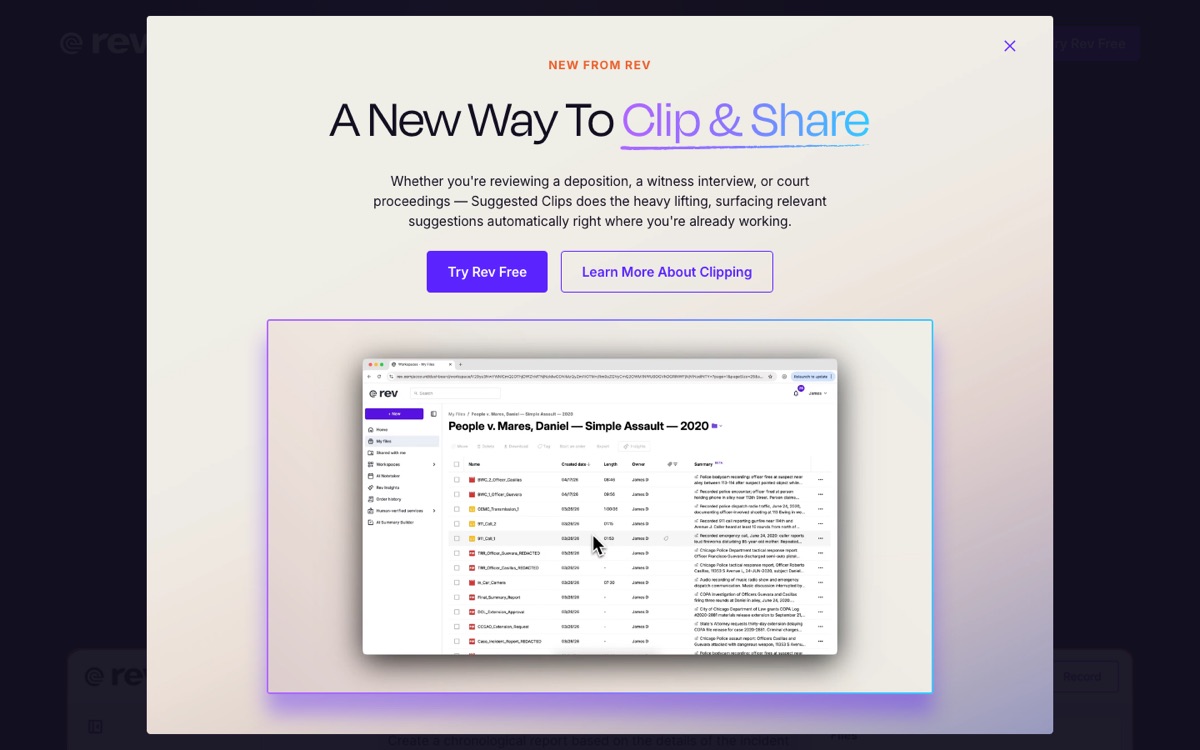 Rev
Rev
|
Yes, AI-to-human upgrade path | General exports, legal-oriented services | Standard SaaS controls | AI + human on demand | Established human service | Human transcripts $1.99/min regular (per-minute usage-based); subscription discounts (as published by the vendor - last checked July 2, 2026) |
| 07 | 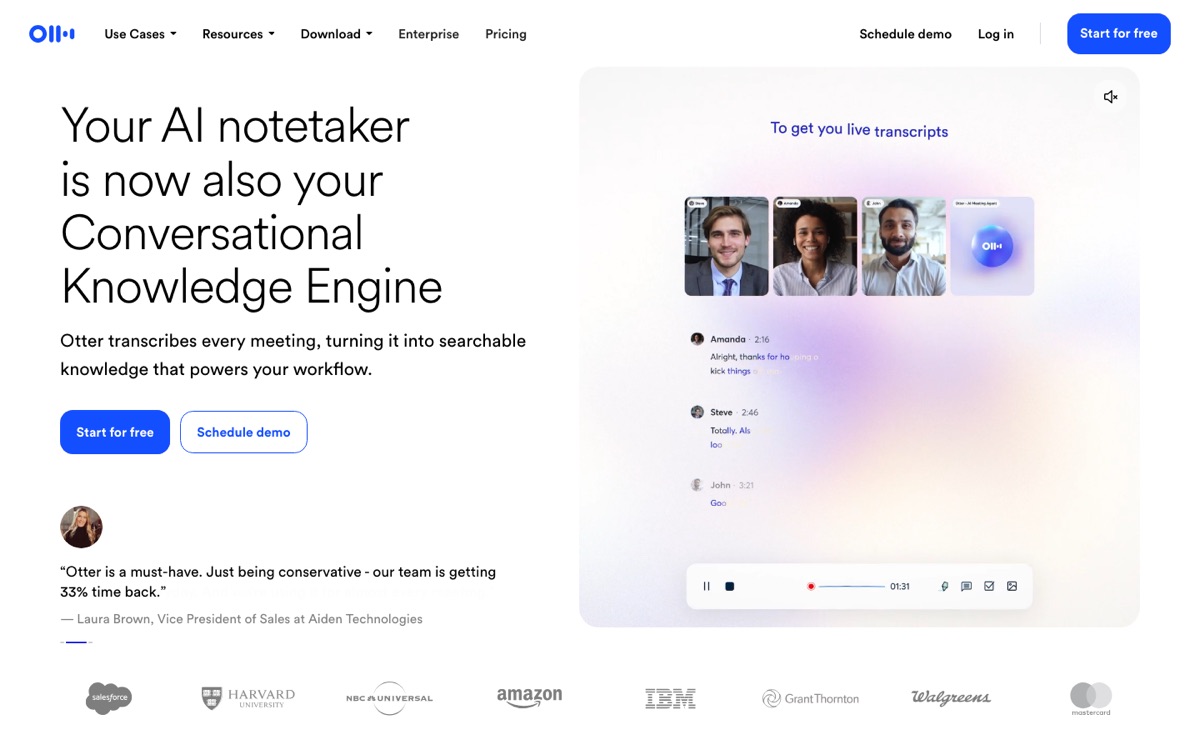 Otter.ai
|
No | Meeting-style exports | Team admin controls | AI-only | HIPAA add-on at Enterprise | Pro $16.99/user/mo monthly (per-user subscription) (Source: otter.ai/pricing - last checked July 2, 2026) |
| 08 | 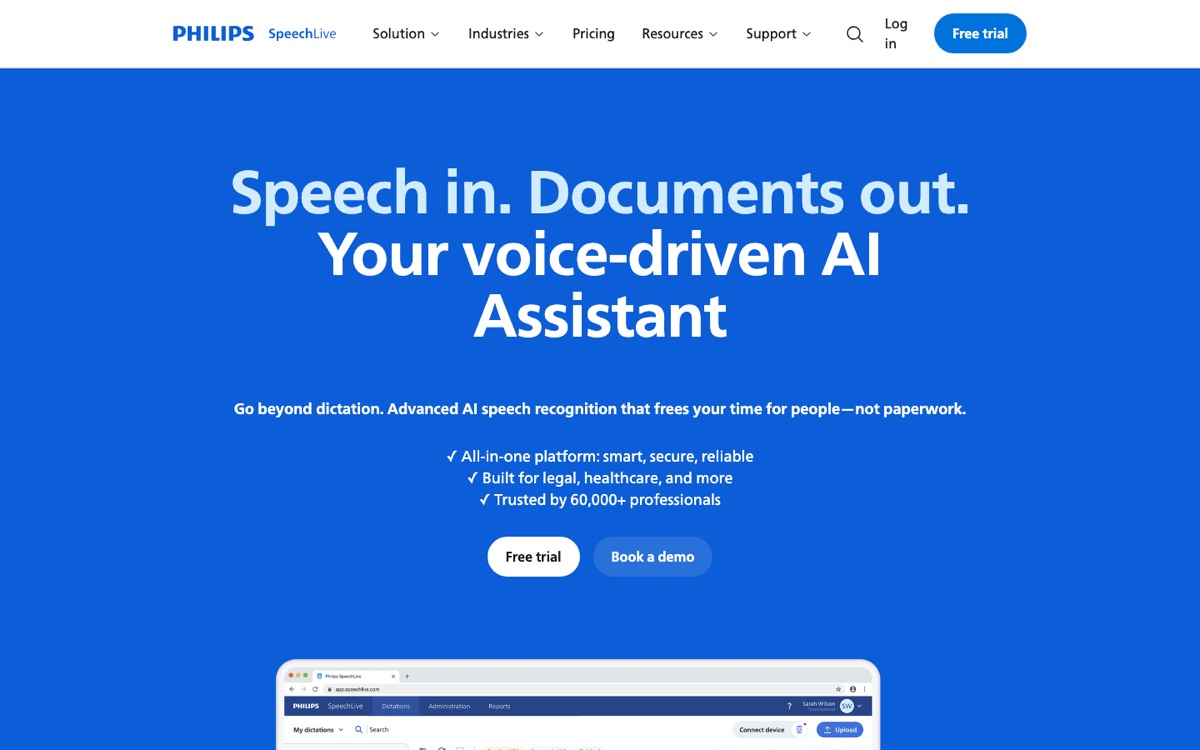 Philips SpeechLive
|
Human transcription service | Dictation-centric output | Dictation workflow controls | Speech recognition + human service | Dictation ecosystem vendor | Subscription plans plus human transcription $1.39/min, English single-speaker (per-minute usage-based) (as published by the vendor - last checked July 2, 2026) |
| 09 | 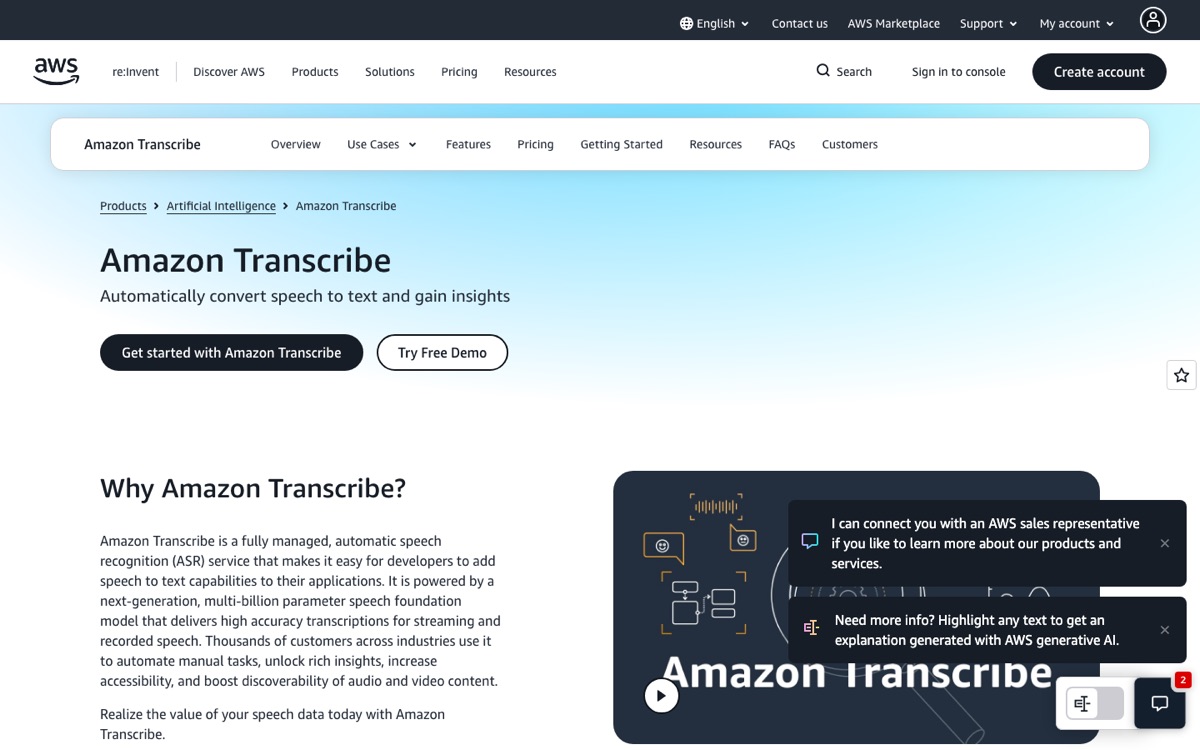 Amazon Transcribe
|
No, build your own | None, raw API output | You build it | AI (developer API) | PII redaction, custom vocabulary | $0.006/min batch Tier 1, US East (usage-based, per-second billing) (Source: aws.amazon.com/transcribe/pricing - last checked July 2, 2026) |
| 10 |
Dragon Legal
|
No, dictation tool | Dictates into your documents | Document-level only | Speech recognition (single speaker) | Legal vocabulary built in | See Nuance shop |
| 11 |  Express Scribe
|
Human transcription utility | Whatever your team produces | Manual process | Human typing with pedal control | Supports encrypted dictation formats | Low-cost license (NCH Software) |
Pricing verified June 2026; custom quotes flagged where vendors publish no rate card.
The L-TRACE checklist to bring to every demo
Must-have
Nice-to-have
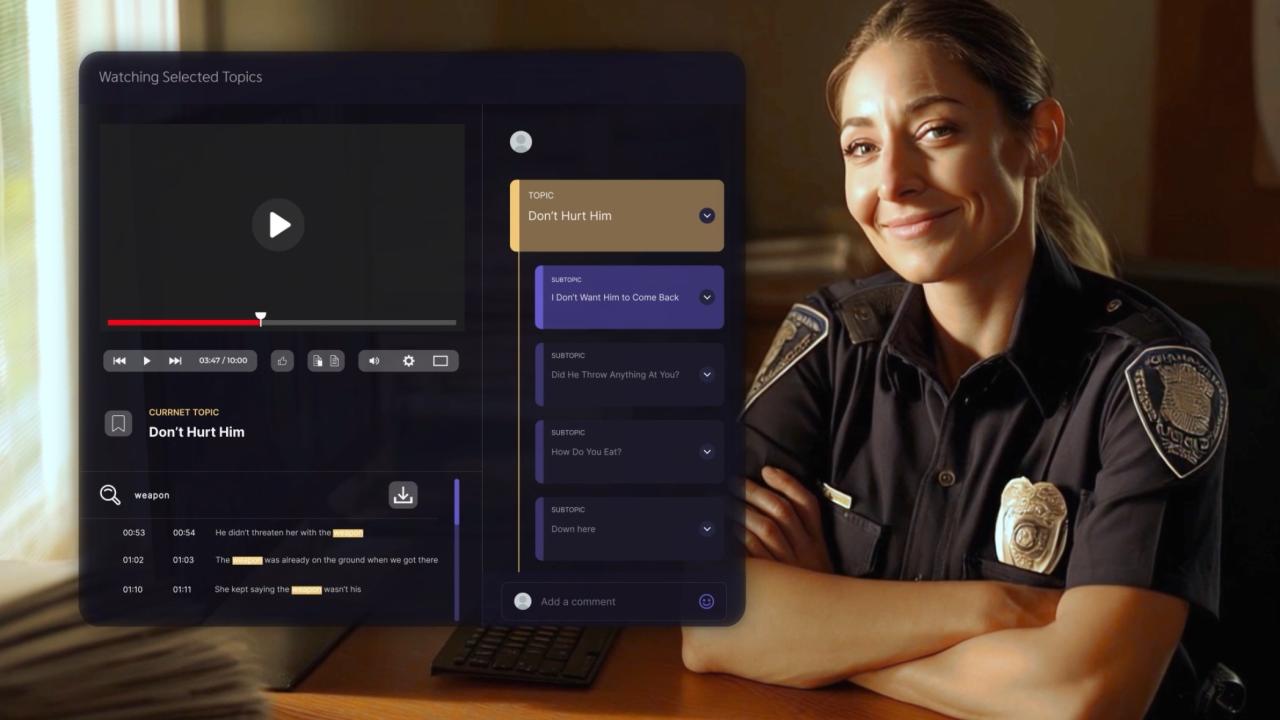
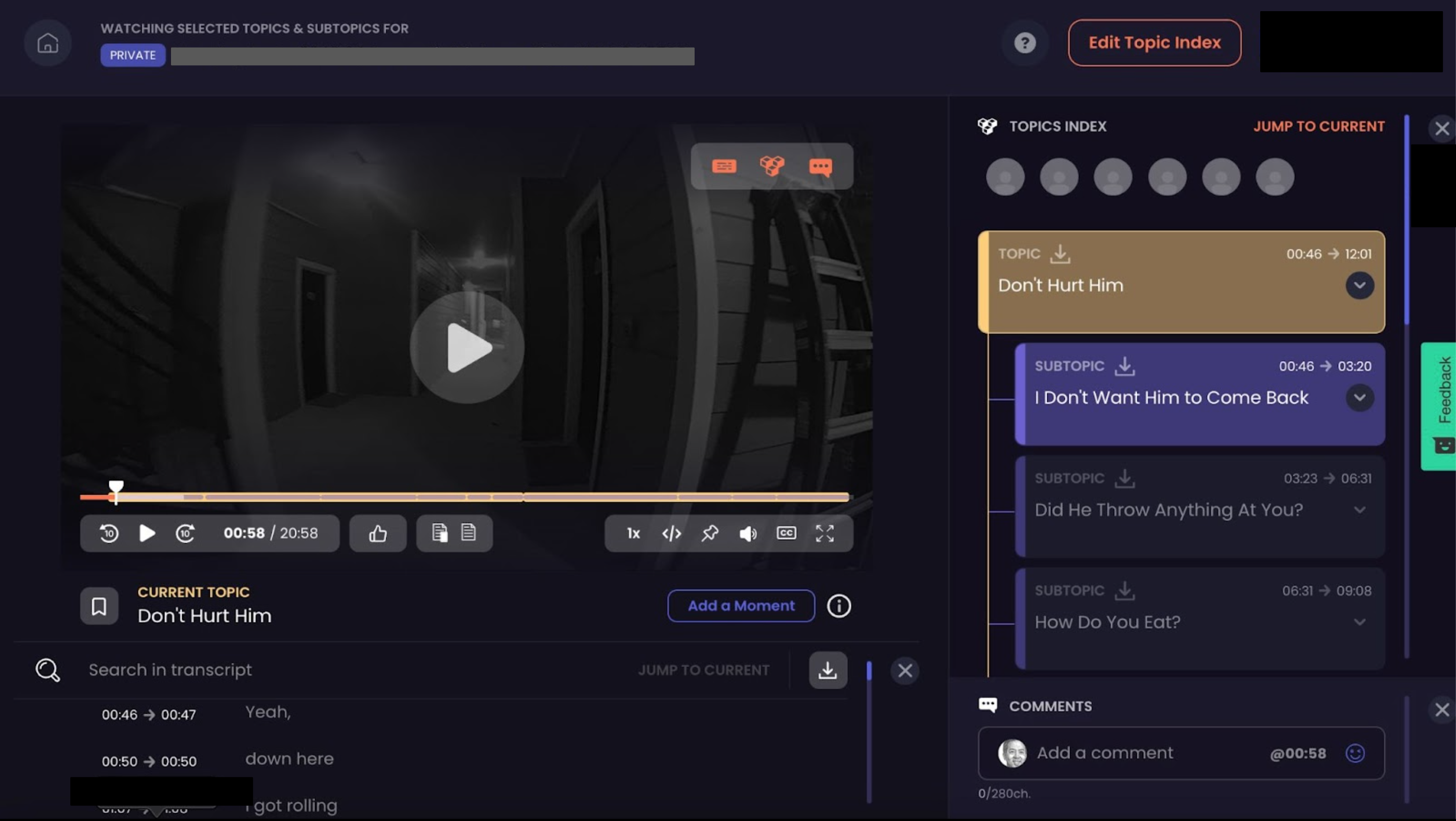
An AI video and audio intelligence platform that turns bodycam, dashcam, and interview-room recordings into speaker-identified, timestamped, searchable transcripts and first-draft investigation reports.
For legal teams, the job is not transcription for its own sake. CLIPr turns bodycam, dashcam, and interview-room recordings into speaker-identified, timestamped, searchable evidence that can be checked against the source audio.
It is strongest when officers, detectives, and downstream attorneys need reviewable records from recorded evidence, not a certified court transcript. The practical takeaway: use CLIPr for evidence search and first-draft investigation reports; use certified transcript vendors when certification is the primary requirement.
One boundary worth stating plainly: CLIPr is not a certified court transcript producer. If your primary requirement is court certification, evaluate Verbit or VIQ Solutions first.
If your primary requirement is evidence ingestion, searchability, and investigative report-drafting from bodycam, dashcam, or interview-room recordings, CLIPr is most relevant.
Pricing: Searchable Audio is $0.105/min and Searchable Video is $0.21/min; investigation teams can start with a free pilot, no credit card required, subject to approval.
For the wider law-enforcement side of this category, see CLIPr's pages on interview-room transcription for detectives, bodycam transcription software, law enforcement software, and how to write a police report.
A legal-first transcription platform combining legal-trained AI speech recognition with certified human transcribers for depositions, hearings, and trials.
Pricing: Custom. Contact sales for a package.
A two-part production pipeline: FirstDraft turns digital recordings into AI drafts, and NetScribe provides the editing and transcript production environment.
Pricing: Custom, and utilization-based rather than per-user. As a public reference point only, a Maricopa County procurement document lists a FirstDraft/NetScribe Enterprise Plus solution at $800/month for over 50 users. Treat that as one negotiated example, not a rate card. (Source: Maricopa County procurement document - last checked July 2, 2026)
Digital court reporting software from Stenograph that pairs the company's Phoenix speech recognition engine with transcript editing, realtime text streaming, and deposition workflows.
Pricing: Custom. Contact Stenograph.
A general-purpose AI transcription platform with a legal industry focus and published compliance posture, used for fast drafts of interviews, hearing recordings, and case prep material.
Pricing: $10/hour pay-as-you-go (utilization-based); Core/Advanced/Pro subscription tiers published. (Source: sonix.ai/pricing - last checked July 2, 2026)
A transcription service offering both AI transcripts and on-demand human transcription, with legal-oriented service pages and subscription discounts.
Pricing: Human transcription $1.99/min regular rate (per-minute usage-based); subscription discounts available. (as published by the vendor - last checked July 2, 2026)
A meeting transcription tool with per-seat plans, used by legal teams for internal meetings, client calls, and working notes rather than official transcripts.
Pricing: Pro $16.99/user/month monthly; Business $19.99/user/month annual to $30 monthly (per-user); HIPAA add-on at Enterprise. (Source: otter.ai/pricing - last checked July 2, 2026)
A cloud dictation workflow from the Philips dictation ecosystem, with an optional speech recognition add-on and a human transcription service priced per minute.
Pricing: Subscription plans published; human transcription from $1.39/min, English single-speaker (per-minute usage-based). (as published by the vendor - last checked July 2, 2026)
Amazon's developer speech-to-text API, used by legal IT and litigation technology teams to build transcription into case systems, evidence platforms, or internal review tools.
Pricing: Pay-per-use (usage-based); example $0.006/min batch Tier 1, US East. (Source: aws.amazon.com/transcribe/pricing - last checked July 2, 2026)
Nuance's legal edition of Dragon speech recognition, built for attorneys dictating directly into documents with legal-specialized vocabulary and automation macros.
Pricing: Listed on the Nuance shop; check current license terms for v16 versus Legal Anywhere.
A professional audio playback utility from NCH Software that gives human transcriptionists foot-pedal and hotkey control over playback speed, rewind, and navigation.
Pricing: Low-cost license; current pricing on the NCH Software site.
The practical answer depends on what happens to the transcript after it exists. Here is the decision framework.
The split running through every row of this framework is the same one the rankings reflect.
Deposition-and-filing work runs on certified transcripts; investigation work runs on recorded evidence, where speaker attribution, timestamps, and searchability help teams review what was said.
That second job is where CLIPr is most relevant, while certified-transcript producers carry the first.
Buying the right tool is half the job. These habits protect the other half.
Capture better audio before blaming the AI. Crosstalk, distant microphones, and phone-speaker recordings are the leading cause of bad transcripts. One microphone per speaker where possible, and test the setup before any interview that matters.
Verify diarization on every multi-speaker file. Speaker misattribution is a high-risk transcript error in legal work, because the text reads clean while assigning words to the wrong person.
Spot-check speaker labels against the audio at several points.
Keep timecodes on. Timestamps let reviewers trace a disputed line back to the relevant moment in the recording. They add little overhead and make review easier.
Preserve the original audio. The recording is the evidence; the transcript is a derivative. Store the source file unmodified, and make sure your tool links the final text back to it.
Log every edit. Use tools with version history where you can, and a documented review procedure where you cannot. Who edited, what changed, and when should be answerable for any transcript that might be challenged.
Standardize your templates. Consistent formatting across matters makes review faster and errors more visible.
Teams that turn transcripts into formal documents downstream can borrow structure from police report writing software workflows, where transcript-to-report conversion is central to the workflow, and from police report writing examples that show what a well-structured narrative built on a transcript looks like.
Escalate to human certification on a clear trigger. Define in advance which outputs must be human-certified: anything filed, served, or quoted in a motion.
The hybrid AI-plus-human pattern is common in regulated fields, including the parallel debate around AI in law enforcement, and legal transcription should be evaluated with the same caution.
An AI transcript by itself is generally not a certified record. Admissibility depends on jurisdiction, authentication, and how the transcript will be used.
For official records, many courts require transcripts produced or certified by a licensed court reporter or qualified transcriber. Use AI drafts for case prep and review; plan on human certification for anything filed or served.
For depositions and proceedings, expect page-line numbered transcripts in full-size and condensed layouts, certificate pages, and litigation-support formats such as ASCII, PTX, or LEF alongside PDF.
General-purpose tools that only export DOCX or subtitle formats will leave formatting work on your desk.
Based on currently published pricing: AI transcription starts around $0.006 per minute for batch at the infrastructure level or $10 per hour of audio in SaaS form. Human transcription runs roughly $1.39 to $1.99 per minute at published rates, with certified and expedited work costing more.
Legal-first platforms like Verbit, VIQ Solutions, and Stenograph use custom pricing.
Free transcription software exists, but it typically lacks the audit trails, exports, and certification paths that make a transcript usable in legal work, so treat free tools as triage, not workflow.
HIPAA is usually relevant when recordings contain protected health information, which happens in medical malpractice, personal injury, and similar matters. For everything else, prioritize a clear security posture: encryption, access controls, and documented handling of who can see the record.
If PHI does appear, confirm HIPAA-eligible terms in writing, such as Otter's Enterprise add-on or HIPAA-eligible AWS Transcribe Medical for built systems.
Through retained original audio, edit history and versioning, user access logs, and a documented review procedure connecting the final transcript back to the source recording.
If your tool cannot show who changed what and when, your process has to. Law enforcement teams that carry transcripts forward into official documents can see how to automate police reports for what that downstream chain looks like in practice.
Verbit and VIQ Solutions are certified court-transcript producers, so they are the right lane when you need a filed deposition or hearing record. They are less of a fit when the job is recorded digital evidence.
For bodycam, dashcam, and interview-room recordings, the useful alternative is a searchable, speaker-attributed record with a first-draft report, which is where CLIPr fits. For a general AI draft versus a certified transcript, weigh Sonix or Rev against Verbit or VIQ Solutions by whether the output will be filed or used internally.
The durable pattern in legal transcription is hybrid: AI for speed, human review for anything that touches the record.
Vendors at different price points now support some version of that pattern, from Verbit's certified Final Transcripts to Rev's per-file human upgrades, while AI-only tools are better treated as draft and review aids.
A practical next step is to run your top 2 candidates on a real recording from a real matter and compare accuracy, speaker attribution, searchability, and export quality for your use case.
A 30-minute test file tells you more than any feature page.
Investigation and public-safety teams evaluating the adjacent problem of turning recorded audio into finished documents can start with this overview of AI police report generator tools.
CLIPr turns BodyCam, DashCam, and interview-room audio into AI-assisted report drafts that officers and detectives review, edit, and save into their records systems.
The platform supports speaker-identified transcripts, timestamps, and searchable notes for investigative work, with a security posture designed around CJIS Security Policy alignment and a SOC 2 security posture. Deployment-specific controls, retention, and deletion terms should be confirmed during procurement.
Run CLIPr on your own interview-room and bodycam recordings. Free 30 to 90 day pilot for up to 50 officers, no credit card required, subject to approval.