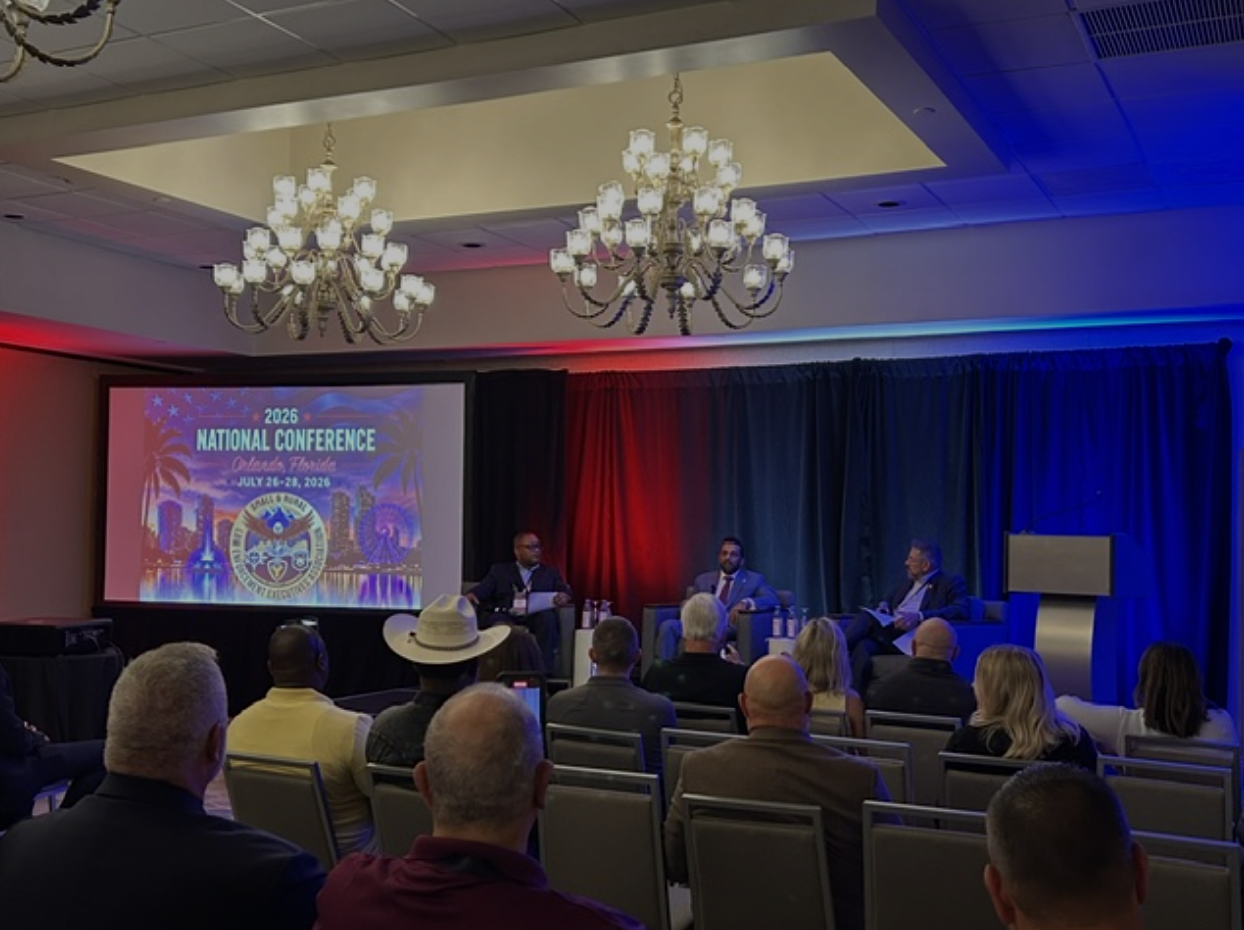
CLIPr Proudly Sponsors SRLEEA Conference in Orlando
At SRLEEA, FBI Director Patel called AI essential for agencies of every size. See how CLIPr is helping small and rural departments do more with less.


Search "Code Four vs Axon" and you are weighing two AI report drafting tools: Code Four REPORT and Axon Draft One. Both turn bodycam recordings into a first draft the officer reviews, edits, and owns. The scope before the verdict:
Code Four REPORT may fit a greenfield or mixed stack that wants multimodal analysis with source-linked review. Axon Draft One may fit an agency already running Axon Evidence with the required Draft One licenses and wanting its native Records or Standards controls. If neither deployment path fits, CLIPr is a separate camera-agnostic option to evaluate against the same evidence requirements.
Disclosure: CLIPr publishes this comparison and offers a separate report-drafting option shown for reference. Its claims are held to the same evidence bar as Code Four and Axon.
The right workflow also depends on the material officers begin with. During evaluation, test representative body-camera audio, officer dictation, typed notes, and uploaded audio clips instead of assuming every report starts from the same input.
The comparison below is a dependency-first decision tool, not a scorecard: the installed stack is the first branch, then input and traceability requirements decide the path.
Each section below carries its own three-way table. The Code Four and Axon columns hold the conditional fit guidance; a third CLIPr (for reference) column shows where a camera-agnostic overlay would sit, since CLIPr publishes this guide.
The decision at a glance
| Decision criterion |  |
 |
 CLIPr (for reference) CLIPr (for reference) |
|---|---|---|---|
| Inputs and review | Multimodal inputs; first draft with statement-to-source links; officer verifies, edits, approves | Audio-powered inputs; side-by-side review, required acknowledgment, supervisor path | Audio-first from existing cameras; officer remains author of record |
| Integration and deployment | Named RMS, CAD, API paths; subscription pilot on the wider family | Native Evidence, Records, Standards; add-on inside the Axon stack | Camera-agnostic overlay; drag-and-drop pilot live within a shift |
| Public price reference | $50 per officer per month (vendor-published) | Quote-based; one published agency quote (Laramie, 2024) | Usage-based: audio $0.105/min, video $0.21/min |
| Where each fits best | Greenfield or mixed-stack agency not locked into Axon, wanting multimodal inputs and source-linked review | Agency already standardized on Axon Evidence, with the required Draft One licenses, wanting native controls | The third option to shortlist: starts light on the camera fleet you already run, draft-first, priced on utilization |
Compiled from current public vendor documentation and procurement records. The CLIPr column reflects CLIPr's own published materials. Re-verify every line in procurement.
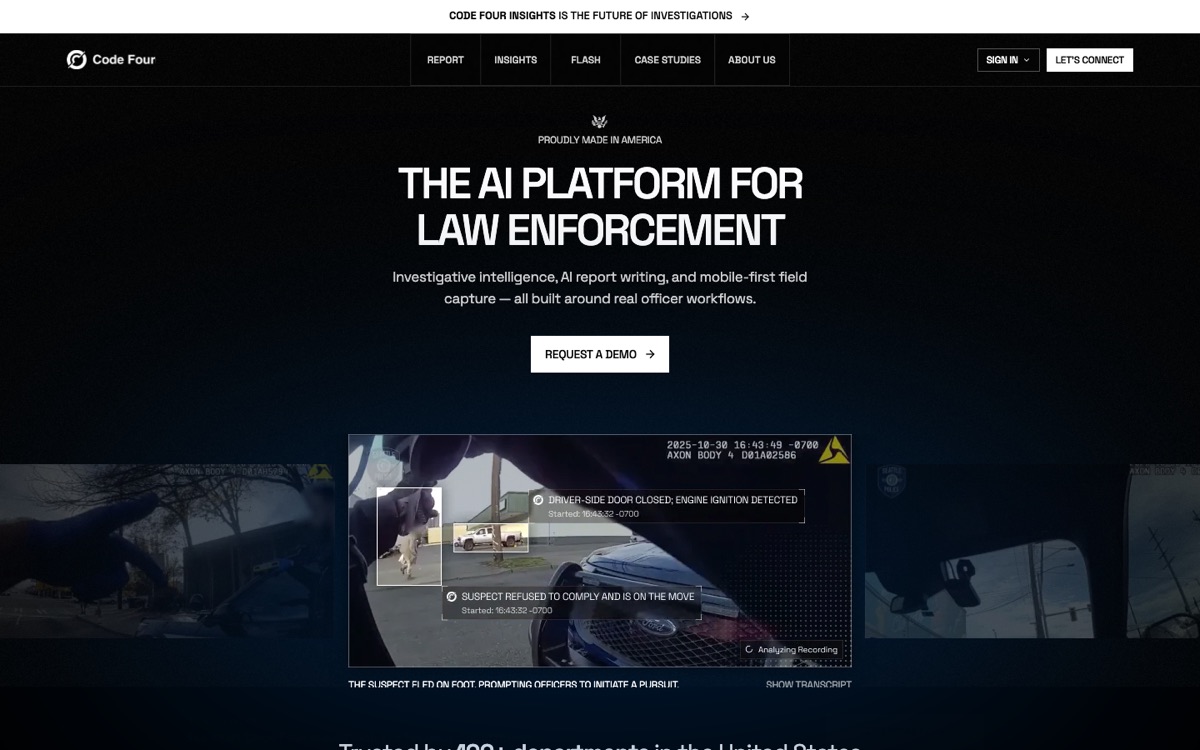
Code Four's product page says REPORT builds a first draft from a wide set of inputs (vendor-reported), and describes a video language model that analyzes frames, audio, and visual content together. INSIGHTS and Flash stay outside this comparison unless contractually part of the REPORT deal.
Axon documents an audio-powered workflow for Draft One (April 2026 records release notes), and its product guide (updated May 28, 2026) states Draft One can use any playable file Axon Evidence supports, so Axon cameras are not strictly required.
One distinction keeps this fair both ways: accepting a playable video file is not the same as analyzing visual events, so Axon's file support is not visual analysis, and Code Four's is not a tested result.
Either way, audio quality is the shared foundation, which is why how bodycam transcription software handles accuracy matters. Scoping wider? These police report writing software evaluation criteria apply beyond this pair.
Scope and inputs, side by side
| Scope and inputs | |
|
CLIPr (for reference) |
|---|---|---|---|
| Inputs the draft draws on | Multimodal: video, transcripts, metadata, dispatch/CAD, notes, photos (vendor-reported) | Audio-powered: recordings, narration or notes, selected evidence, report fields (published) | Field and bodycam audio, transcribed and speaker-identified |
| Visual analysis and footage source | Video language model (vendor-reported, not tested); named camera and evidence paths | Audio-powered; visual analysis not documented; Axon Evidence plus playable files | Audio-first; any fleet including Axon, Motorola, Getac, Reveal, i-PRO |
Code Four has the broader documented input-analysis claim. Axon has the more clearly documented audio and native report-context workflow.
Both vendors keep the officer as the author, the load-bearing part of this category. Code Four describes its output as a first draft: officers verify facts, edit, and approve, and its enterprise terms (updated December 23, 2025) keep the officer responsible for signing.
Its pages also describe statement-to-source links and timestamps (vendor-reported).
Review workflow, side by side
| Officer review | |
|
CLIPr (for reference) |
|---|---|---|---|
| Ownership and sign-off | Officer verifies, edits, and signs (enterprise terms hold the officer responsible) | Officer edits; required acknowledgment; side-by-side review, supervisor path in Records or Standards | Officer reviews, edits, and remains author of record; nothing files itself |
| Tracing back to the evidence | Statement-to-source links and timestamps (vendor-reported) | Side-by-side review; statement-level links not documented | Speaker-identified, timestamped transcripts to search and cross-check |
Axon documents a required acknowledgment before a draft becomes a report and a supervisor path in Records or Standards; its FAQ says drafts can contain mistakes and require sign-off. Neither workflow files anything itself: under both, the officer reviews, edits, approves, and owns the report.
Code Four holds the public edge on statement-to-source positioning; Axon holds it on product-specific sign-off and native supervisor controls. Put both through the same review scenario and see which one your officers trust under a full report queue.
Retention, version history, audit events, and usage reporting answer different questions, so evaluate them separately, not as one "audit" feature.
Retention and audit, side by side
| Retention and audit | |
|
CLIPr (for reference) |
|---|---|---|---|
| Retention and versions | Versioned drafts claimed (deployment-specific); agency decides retention, subject to contract | Original-draft retention optional, off by default, original only; agency decides within those defaults | Customer retains ownership per CLIPr's published terms; agency sets retention in procurement |
| Audit events | Immutable logs: login, access, generation, edits, approvals (published) | Request and sign-off events, usage reports, downloads, deletions (published) | SOC 2 compliant architecture; audit posture verified in the agency review |
Per Axon's auditing and reporting guide (updated June 10, 2026), the precision that matters is this: Axon's original-draft retention is optional, off by default, and saves only the original unedited AI draft; edited versions are not saved.
This control has a public history: in July 2025 the Electronic Frontier Foundation argued that Draft One's handling of original drafts frustrated public-records transparency, and Axon's current guide documents the setting and its defaults.
Whether the configured behavior satisfies your records obligations is an agency decision, not a vendor default.
Axon publishes more product-specific retention and reporting behavior; Code Four publishes a stronger edited-version-history claim. Neither public page settles your records obligations without configuration and contract review.
Compare the actual data path, not vendor adjectives.
Integrations, side by side
| Integrations | |
|
CLIPr (for reference) |
|---|---|---|---|
| Camera fleet | Named camera and evidence paths for mixed fleets | Native to Axon Evidence; playable third-party files accepted | Camera-agnostic; CLIPr names Axon, Motorola, Getac, Reveal, and i-PRO among supported vendor families. Verify the exact model, export, metadata, and handoff in the pilot. |
| RMS and CAD path | Named RMS, CAD, API paths (deployment-specific); validate the exact path in your environment | Native Records or Standards, or narrative copied into a third-party RMS | Overlay beside the existing RMS; not an RMS, CAD, or DEMS |
Code Four's integrations page names Axon Evidence, Motorola, Getac, JailCore, Securus, Tyler Technologies, Mark43, Motorola PremierOne, middleware, and custom APIs (vendor-published). A named vendor is a starting point, not a validated connection.
For either product, verify the boring specifics before contract: camera model, file type, and metadata; export permissions and API entitlement; data-flow direction and field mapping; retries, duplicates, and latency; and support ownership and added cost.
Axon is the lower-change fit inside a qualified Axon stack. Code Four is the stronger mixed-stack candidate, but only when its exact named or API path validates in your environment.
Every public number below carries a date and a context, and none is your quote.
Normalize before comparing anything:
annual evaluated cost = licenses + prerequisites + processed usage + storage + implementation + integrations + support + training + internal review labor + export and termination costs
Pricing, side by side
| Pricing | |
|
CLIPr (for reference) |
|---|---|---|---|
| Reference and model | $50 per officer per month (vendor-published); per-officer subscription | Quote-based, one published agency quote (Laramie, 2024); per-license plus add-ons | Usage-based (audio $0.105/min, video $0.21/min); unused capacity carries forward |
| Prerequisites | Subscription; confirm specifics in a quote | Add-on, Unlimited Auto-Transcribe, Evidence Pro; Respond+ for LTE upload | None to start; 30-day agency pilot, subject to approval, with no dock required for the initial upload workflow |
Code Four has the lower and simpler public starting reference. Neither product should be called cheaper until comparable current quotes define inclusions and usage.
Treat this section as a gate, not a scoring category: a product either produces the evidence your agency requires or it does not advance, and publication volume is not a quality score. Code Four's published set includes a data processing agreement (DPA) summary; Axon adds a broader trust portal.
Security posture, side by side
| Security posture | |
|
CLIPr (for reference) |
|---|---|---|---|
| Published materials | Encryption and authentication, roles, audit, DPA summary, subprocessors, incidents | Data-location, audit, retention detail, plus a broader trust portal | SOC 2 compliant architecture; documentation supplied during procurement |
| Compliance and ownership | Agency-level CJIS review; ownership per contract and DPA terms | Agency-level CJIS review; ownership per contract and trust-portal terms | CJIS Security Policy-aligned, reviewed at agency level; customer retains ownership per CLIPr's published terms |
Request from each: deployment architecture; identity, roles, and authentication; encryption and key management; audit schema, retention, and export samples; independent assessment status; data storage, retention, and deletion terms; incident response; and the DPA and order form.
Frameworks like the FBI's Criminal Justice Information Services (CJIS) Security Policy apply to the whole deployment, so evaluate them as agency-level reviews rather than vendor badges.
This guide to law-enforcement data compliance covers how to run that evidence request evenly; do not draw a certification conclusion for either vendor from public marketing.
No independent Code Four versus Axon head-to-head was found in this review, and results vary by agency, case mix, and rollout, so the number that matters is the one you measure on your own reports.
Independent local reporting from The Maine Monitor, February 24, 2026, confirms one Wilton, Maine Code Four deployment with human editing and sign-off; that corroborates the workflow, not a controlled result, so keep vendor time-savings claims labeled vendor-reported.
If you want a low-commitment way to generate that local number, CLIPr offers a 30-day agency pilot for up to 50 officers, subject to approval, and the same fair-pilot design below applies to whichever tool you test.
The default recommendation, stated plainly: if the pause conditions do not apply and your agency is not committed to an Axon software path, pilot Code Four REPORT first. If you already run the qualified Axon stack, evaluate Axon Draft One first.
Whichever product you evaluate first, the pilot design should be identical so the results are comparable. It follows the phased, review-first approach in DOJ COPS Office guidance (January 2025), and pairs with a phased police-report automation plan if you are writing rollout policy too.
Consult prosecutors, legal counsel, records staff, labor representatives, security, and community stakeholders as appropriate. Turn the comparison above into your procurement worksheet, then request comparable current quotes and deployment evidence from both vendors before anyone signs.
Some agencies do not fit either mold: not ready to commit to Code Four's wider family, and not standardized on the Axon ecosystem Draft One expects. That gap is where a camera-agnostic, start-light option earns a look.
CLIPr publishes this comparison and appears in the reference column and the verdict throughout; hold it to the same evidence bar as the two products above.
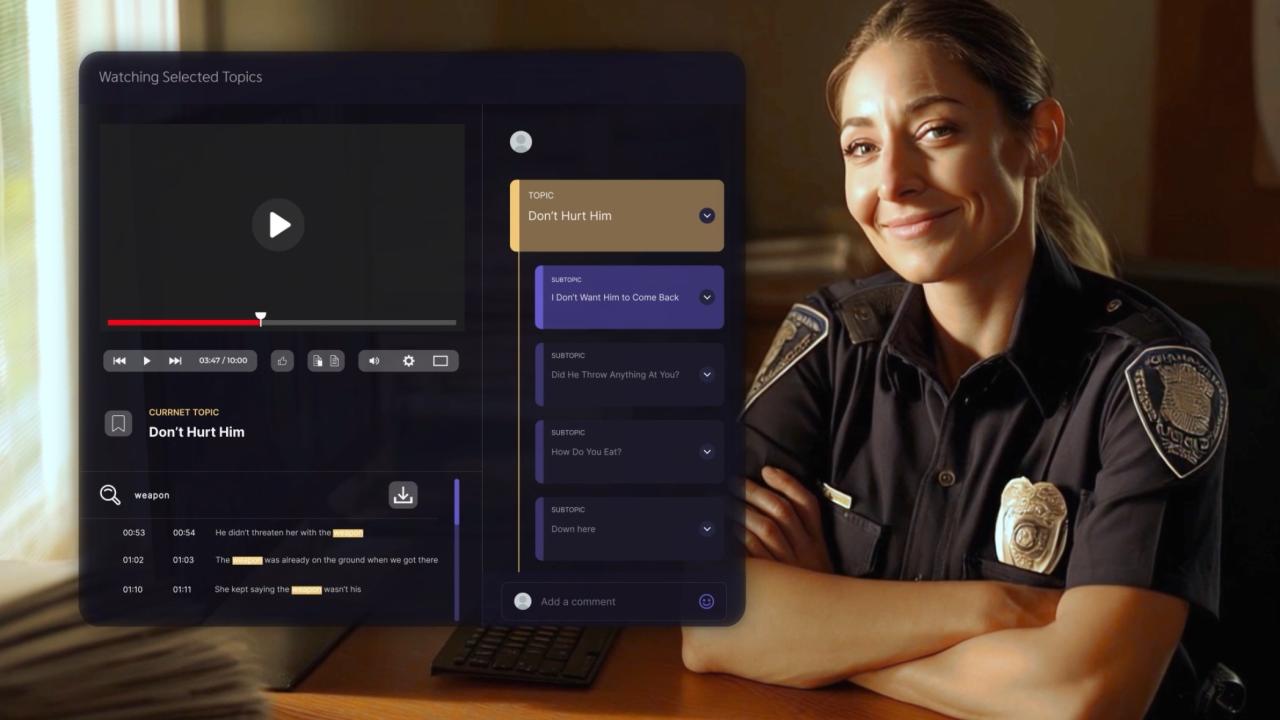
CLIPr is built for exactly that opening: an agency can begin drafting with drag-and-drop transfer from the camera platform it already runs, no rip-and-replace. Officers stay in charge, reviewing, editing, and copying each first draft into the current RMS, and own the final report.
Capture is not tied to a dock: CLIPr Mobile on iOS and Android lets field personnel record incident audio from a phone or tablet, feeding the same first draft the officer reviews.
You can start small and grow, with dock-assisted upload later and a usage-based reference model rather than a per-seat rate, so a pilot does not mean buying a seat for every officer on day one.
The same evaluation discipline applies to CLIPr as to any option here. CLIPr is not an RMS, CAD, or DEMS, and a direct RMS handoff is conditional on the RMS vendor, version, API access, security review, implementation, contract, and agency approval.
Agencies can evaluate CLIPr's staged workflow using the exact criteria and pilot protocol laid out above.
Building a wider shortlist? Two roundups apply the same evaluation lens to each product's field: Axon Draft One alternatives and Code Four alternatives.
For agencies, yes. Code Four REPORT and Axon Draft One are the like-for-like AI-assisted police report drafting products buyers mean.
The short query collides with unrelated meanings: code four is a radio status phrase, and Axon also names a programming language and a body-camera line. INSIGHTS, Flash, and Axon hardware sit outside this comparison except where a prerequisite affects price or workflow.
Not according to Axon's own documentation. Axon's Draft One product guide (updated May 28, 2026) states Draft One can use playable audio or video files supported by Axon Evidence, not only Axon camera footage.
The documented prerequisites are software: the Draft One add-on, Unlimited Auto-Transcribe, and Evidence Pro, with Respond+ for rapid LTE audio upload.
Code Four says it does: its product page describes a video language model that analyzes frames, audio, visual content, and metadata together.
That is vendor-reported capability, not an independently tested result, so a pilot should include incidents where the decisive detail is visual only, then check what the draft does with it.
They publish different strengths. Code Four's pages describe statement-to-source links, timestamps, version history, and action logs covering login, access, generation, edits, and approvals.
Axon's auditing guide (updated June 10, 2026) documents request and sign-off events, usage reports, and an optional original-draft retention setting that is off by default and saves only the original unedited draft. Both need deployment-level verification.
Code Four publishes $50 per officer per month. Axon pricing is quote-based: cooperative contract pricebooks publish contract-maximum rates for the Draft One SKU before its required add-ons, and one published agency quote is the July 2024 City of Laramie document.
Neither public reference is total cost, so compare complete current quotes covering prerequisites, usage, storage, implementation, support, and exit terms.
For the Code Four vs Axon decision, the dependency-first read still holds between the two. A greenfield or mixed-stack agency should advance Code Four REPORT to a controlled pilot, matching multimodal inputs, source-linked review, named cross-system paths, and a simpler published rate.
An agency already standardized on Axon Evidence and the required products should evaluate Axon Draft One first, as the lower-change path with more detailed product-level audit, reporting, and retention controls.
CLIPr is a third option to shortlist when the agency wants to retain its camera fleet and keep the officer reviewing, editing, and owning each draft-first report. The appropriate choice should come from the same local evidence set, procurement gates, and reviewer rubric used for Code Four and Axon.
CLIPr prices on utilization you can validate through the 30-day agency pilot for up to 50 officers, subject to approval.
Security, records, legal, and total-cost gates can stop any of these paths, and no public page replaces a fair local test on your agency's own evidence.
The CLIPr Team writes about AI-assisted documentation for law enforcement.
CLIPr turns BodyCam and DashCam audio into AI-assisted first drafts of police reports that officers review, edit, and approve into their existing RMS, backed by a SOC 2 compliant architecture and a design that is CJIS Security Policy-aligned.
Code Four REPORT and Axon Draft One both earn a fair pilot before anyone signs.
And if neither deployment model fits your stack, the third path runs the same protocol: your footage, your officers reviewing and approving every draft, your RMS copy step, backed by a 30-day agency pilot for up to 50 officers, subject to approval.