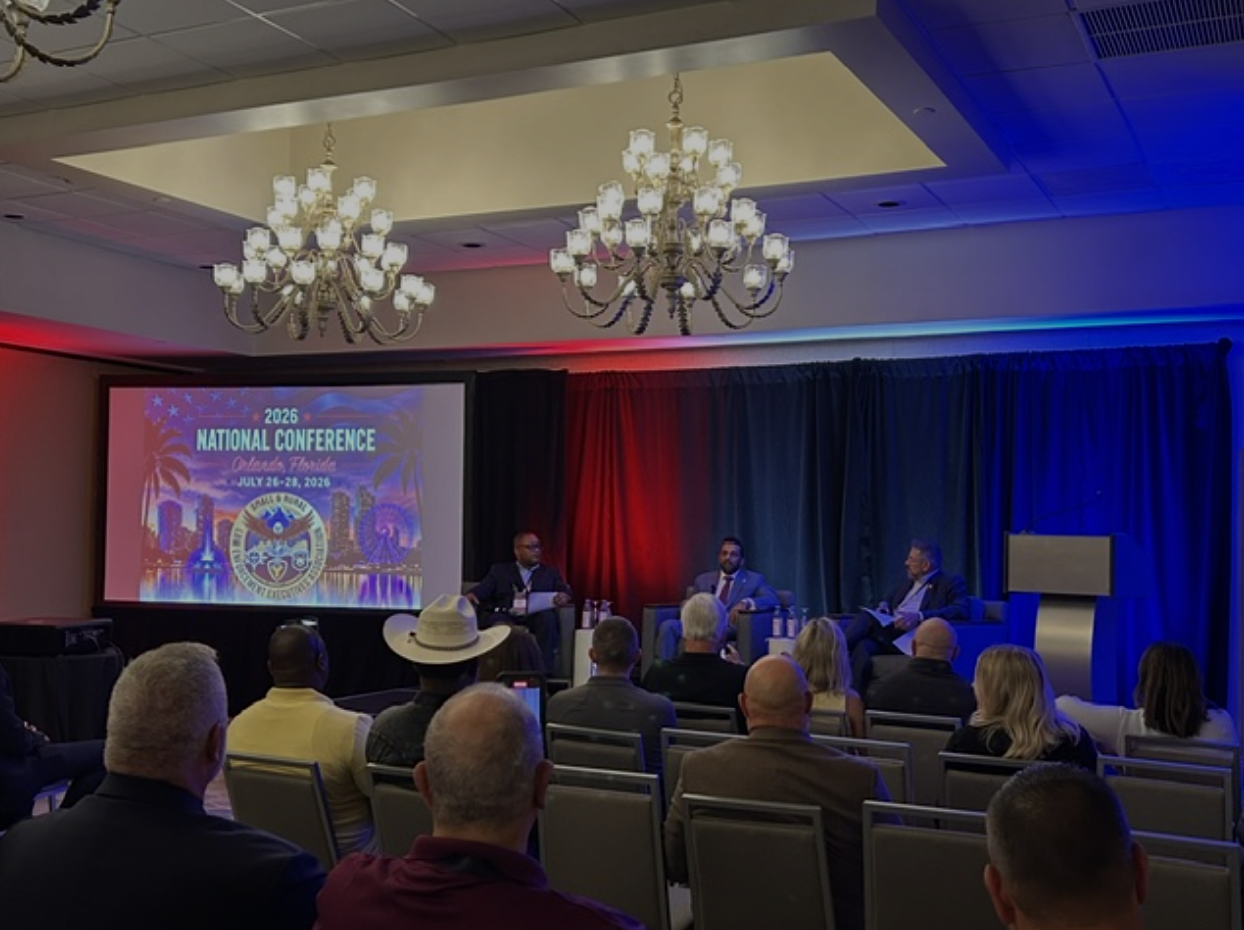
CLIPr Proudly Sponsors SRLEEA Conference in Orlando
At SRLEEA, FBI Director Patel called AI essential for agencies of every size. See how CLIPr is helping small and rural departments do more with less.



Ten case management options for detective units and PI firms, evaluated on compliance posture, caseload views, evidence workflows, integrations, and total cost, with published pricing where it exists.
If you are a detective sergeant or investigations lieutenant at a 20 to 300 sworn agency, shopping for case management software means wading through three different product categories that all claim the same job. RMS vendors sell "investigations modules." Standalone platforms call themselves investigation case management. Digital evidence systems pitch "virtual case folders."
Then half the search results are private investigator tools with client portals and invoicing, which solve a completely different problem.
This guide evaluates 10 detective case management options against the criteria investigators actually use: compliance posture, caseload and assignment views, evidence workflows, integrations, and total cost. It includes published pricing where it exists, procurement-friendly sources like GSA schedule line items, and a clear split between police detective systems and PI agency tools.
A note on perspective: this guide is published by CLIPr, which makes AI-assisted police reports from bodycam and interview-room audio. CLIPr pairs with the case systems below rather than competing with them, which is exactly why the "report drafting" gap in this category gets honest treatment here.
Before comparing vendors, get the categories straight. Most bad purchases in this space happen because an agency bought the wrong category, not the wrong brand.
The detective's working environment: case files, assignments, tasking, leads, entities, notes, and supervisor views across the life of an investigation.
The agency's system of record for incidents and reports. Many RMS platforms now include an investigations or case module. Axon's investigations documentation is a useful public example of how a case lifecycle sits inside an RMS.
Ingest, organize, and share bodycam video, interview-room recordings, CCTV, and citizen uploads. A DEMS complements a CMS or RMS. It is rarely a primary case system on its own.
With that frame, the evaluation below scores every option on seven dimensions:
Most roundups stop at feature lists. This one includes a weighted scoring model you can put in front of command staff and IT.
CASE-FIT weights the seven dimensions above by how much they actually drive day-two satisfaction in detective units. Compliance and evidence carry the most weight because they are the hardest to retrofit. Score each shortlisted vendor 1 to 5 on each dimension during demos, multiply by the weight, and total it.
Blank scoring template for your shortlist:
| Vendor | C (20%) | A (15%) | S (15%) | E (20%) | F (10%) | I (10%) | T (10%) | Weighted total |
|---|---|---|---|---|---|---|---|---|
| Option 1 | ||||||||
| Option 2 | ||||||||
| Option 3 |
A worked example with real scenarios appears in the decision section below.
| # | Tool | Standout strength | Pricing / seat minimum | Best for |
|---|---|---|---|---|
CLIPrComplementary interview-reporting layer
|
CLIPr turns supported interview-room, body-camera, and dash-camera recordings into speaker-identified transcripts and AI-assisted first-draft investigation reports. The case platform keeps tracking the investigation, while the detective reviews, edits, and owns the report. Verify the exact case and RMS handoff during the pilot.
Request a 30-Day Agency Pilot
|
|||
| 01 |  Kaseware Published pricingStandalone investigations platform
|
Published per-user pricing, rare in this market | Public pricing page; 20 users (40 on top tier) | Agencies and investigation teams that want transparent costs |
| 02 |  Case Closed SoftwareLE investigation CMS
|
Specialized unit modules (narcotics, CI, gang) | Custom pricing; minimum not published | Detective units with specialized squads |
| 03 |  Hexagon HxGN OnCall RecordsRMS with investigations
|
Records plus analytics in one Hexagon stack | Custom pricing; minimum not published | Agencies standardizing on Hexagon |
| 04 |  Mark43 RMS Case ManagementCloud RMS case module
|
GSA schedule line items, FedRAMP variants | GSA schedule prices; per contract | Agencies that want a modern RMS with a public procurement path |
| 05 |  Omnigo Investigation Case ManagementSuite CMS module
|
Ties into Omnigo RMS, dispatch, evidence | Custom pricing; minimum not published | Agencies already in the Omnigo ecosystem |
| 06 |  Axon Records (Case & Investigations)RMS case module
|
Detective assignment and lifecycle inside the Axon stack | Custom pricing; minimum not published | Axon BWC/evidence agencies |
| 07 |  NICE InvestigateDEMS with detective workflows
|
Virtual case folders, multi-source evidence ingestion | Custom pricing; minimum not published | Evidence-heavy investigations, paired with an RMS/CMS |
| 08 |  CentralSquare RMS + DEMSRMS plus DEMS
|
Case workflows plus digital evidence sharing in one vendor | Custom pricing; minimum not published | CentralSquare public-safety suite agencies |
| 09 |  CROSStraxPI case management
|
Client portal, billing, report packaging | Public pricing page; minimum not published | Private investigation agencies |
| 10 | 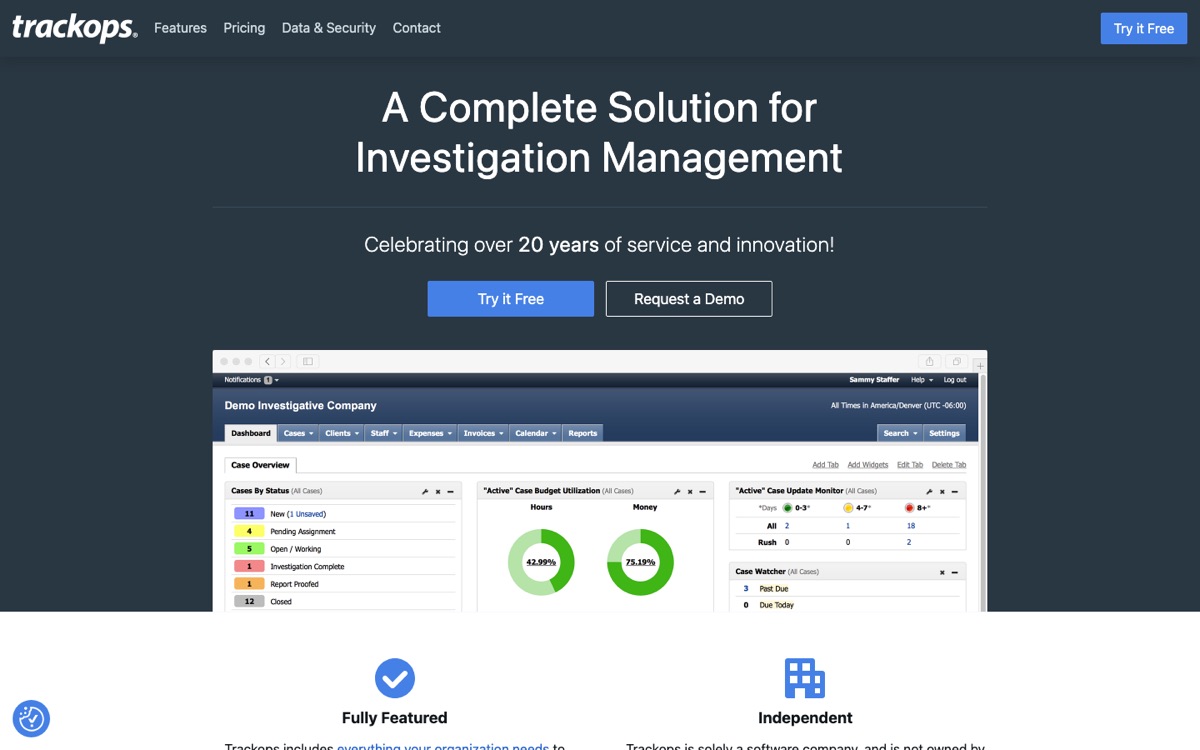 TrackopsPI case management
|
Time, expense, and case profitability tracking | Public pricing page; minimum not published | PI shops managing budgets and margins |
Pricing and pilot terms verified June 2026.
A standalone investigations platform built for case management, link analysis, and investigative workflows, sold per user rather than as an agency-wide RMS replacement.
Pricing: Published pricing as of June 10, 2026: Essentials at $102 per user per month (20-user minimum), Insights at $158 per user per month (20-user minimum), and Connections at $216 per user per month (40-user minimum). Source: Kaseware pricing page.
The 20-user minimum on the entry tier prices out very small detective units, and the top tier requires 40 users.
An investigation case management system built specifically for law enforcement, positioned by the vendor as CJIS-compliant investigation case management.
Pricing: Custom pricing.
As a standalone CMS, it depends on integrations to connect with your RMS and evidence stack; verify your specific systems during evaluation.
Hexagon's records management offering, with investigations coverage and analytics as part of the broader HxGN OnCall public-safety suite.
Pricing: Custom pricing.
Committing to a full suite is a bigger organizational decision than adding a standalone CMS; score "I" and "T" carefully if you are not already a Hexagon shop.
A cloud-native RMS whose case management module supports configurable case types and detective workflows.
Pricing: GSA schedule line items for the RMS Case Management module list Standard at $194.66, Pro at $355.84, and Premium at $486.65, with FedRAMP variants at $243.32, $437.98, and $600.79. Units and terms are as documented in the GSA price list. Source: GSA MAS price list, accessed June 10, 2026.
As with any RMS module, report drafting is still manual; the case file tracks the work, it does not write the narrative. That gap is covered in the police report writing software category breakdown.
Only two options in this roundup give you public numbers before a sales call. Kaseware publishes per-user pricing with seat minimums, and Mark43's case management module has line items on the GSA schedule. Both verified June 10, 2026. Bring these to budget conversations as anchors even if you buy something else.
Omnigo's investigation case management solution, part of a broader suite covering RMS, dispatch, and evidence.
Pricing: Custom pricing.
The value case is strongest inside the Omnigo ecosystem; standalone adoption means scoring the "I" dimension against your current RMS and evidence systems.
The case and investigations capability inside Axon Records, the RMS arm of the Axon ecosystem most agencies already know from body-worn cameras and Evidence.com.
Pricing: Custom pricing.
The value depends heavily on being an Axon agency. Outside the stack, the integration advantage disappears.
A digital evidence management system (DEMS) with detective workflows, built around "virtual case folders" that pull bodycam, CCTV, interview-room, and citizen-submitted evidence into one place per case.
One adjacent gap worth knowing: a DEMS organizes recordings, but turning a recorded interview into usable text is a separate job. That is where legal transcription for interviews and statements enters the workflow.
Pricing: Custom pricing.
It is a DEMS, not a primary case system. Plan to pair it with your RMS or CMS rather than replace one.
CentralSquare's records management system paired with its DEMS offering, covering case workflows and digital evidence sharing under one public-safety vendor.
Pricing: Custom pricing.
Dedicated investigations depth (specialized unit workflows, link analysis) deserves scrutiny in demos against standalone CMS options; score the "S" and "A" dimensions with your own case scenarios.
Case management built for private investigation firms, where the "case" includes a paying client, not just an incident number.
Pricing: Published pricing available on the CROSStrax pricing page.
PI-focused case management with an emphasis on the business side of investigations: time, expenses, and case profitability.
Pricing: Published pricing available on the Trackops pricing page.
Run your shortlist through the grid with your own constraints. Two worked scenarios show how the weights play out.
Scenario 1
A 70-officer department with interview-room recordings
Compliance (C) and evidence integration (E) dominate at a combined 40% of the score. This agency should shortlist an RMS-integrated case module (Axon Records, Mark43, or its existing suite vendor) or a standalone platform like Kaseware, then pair it with a DEMS if evidence volume justifies one.
The piece no CMS or RMS on this list covers: turning recorded interviews into transcripts and first-draft reports. Pairing the case system with detective interview-room report automation closes that gap without replacing anything.
An illustrative scoring pass for this department might look like this (your scores will differ; that is the point of the exercise):
| Vendor (illustrative) | C (20%) | A (15%) | S (15%) | E (20%) | F (10%) | I (10%) | T (10%) | Weighted total |
|---|---|---|---|---|---|---|---|---|
| RMS-integrated module | 4 | 4 | 3 | 5 | 3 | 4 | 2 | 3.75 |
| Standalone CMS | 4 | 4 | 4 | 3 | 3 | 3 | 5 | 3.70 |
A near-tie like this tells you the decision hinges on your tiebreakers: existing vendor relationships, evidence volume, and pricing transparency.
Scenario 2
A 6-investigator PI firm
Compliance and DEMS integration barely matter; client billing, report packaging, and total cost matter enormously. Re-weight the grid accordingly and the shortlist becomes CROSStrax and Trackops, decided by whether client portal polish or profitability tracking is the bigger daily need.
If report writing time is the actual bottleneck rather than case tracking, evaluate an AI police report generator alongside whichever case system wins your scoring.
Every tool above manages the case. None of them writes the report.
That gap is bigger than it looks. CLIPr's detective product page cites an average suspect interview length of 1.6 hours and more than 40% of investigator time going to administrative duties and report writing. The case file tracks that work; it does not do it.
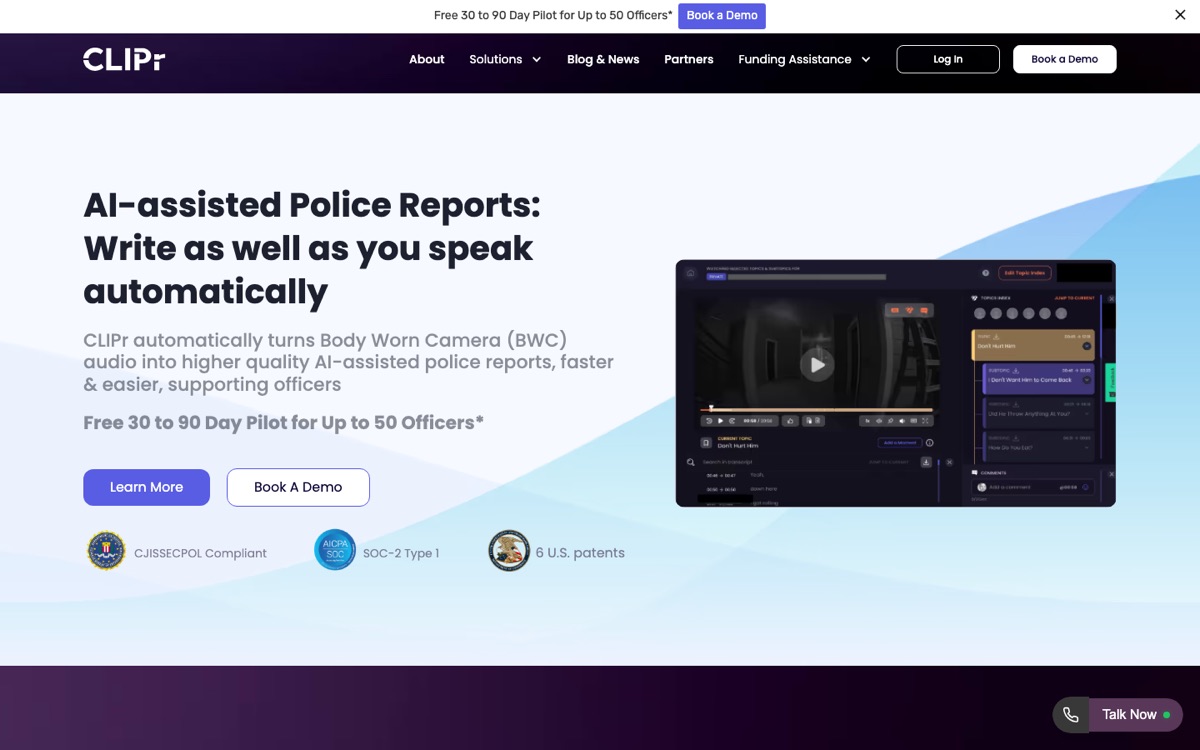
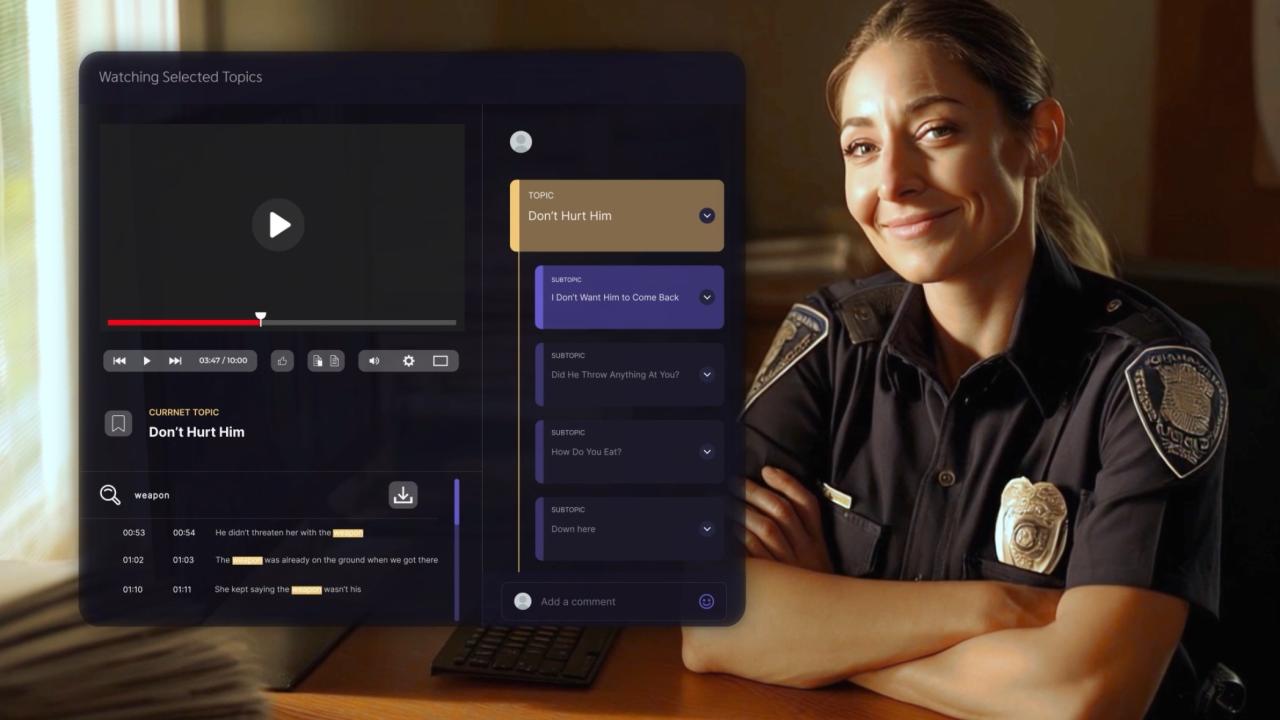
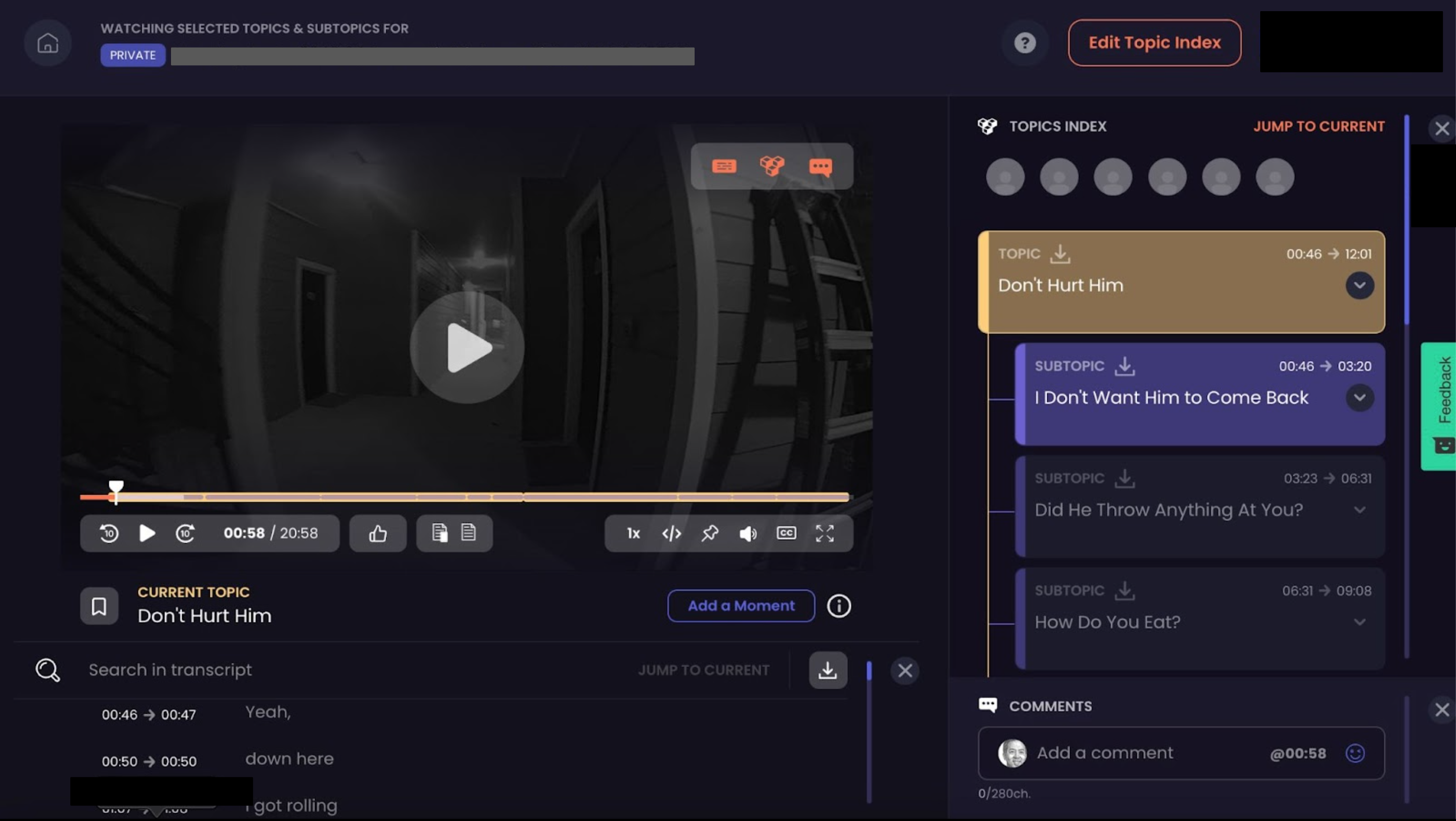
CLIPr turns interview-room audio and video into speaker-identified transcripts with timestamps, summaries, flagged key moments, Q&A search, and structured first-draft investigation reports. The detective reviews and edits every draft, then copies the finished, certified report into the existing RMS. Nothing is filed without human review, and CLIPr integrates with RMS and evidence platforms without rip-and-replace.
For the compliance column of your grid: CLIPr's public pages display CJISSECPOL Compliant and SOC-2 Type 1 badges, and its data ownership stance means the agency keeps control of its files.
Detective case management software, often searched as police case management software or investigation management software, is the working environment for investigations: case files, assignments, leads, entities, and supervisor views. An RMS is the agency's system of record for incidents and reports, and many RMS platforms include a case module, as shown in Axon's investigations documentation. A DEMS organizes digital evidence like bodycam and interview recordings and works alongside a CMS or RMS rather than replacing either.
Look for vendor-documented CJIS Security Policy alignment, SOC 2 attestation, and FedRAMP or GovCloud hosting options where federal requirements apply. Be precise about language: there is no such thing as "CJIS certified," so evaluate vendor-stated compliance claims. Kaseware is a useful public example, listing SOC 2 Type II, NIST 800-53, and GovCloud options on its pricing and features page.
Most do not, but two public reference points exist in this roundup. Kaseware publishes per-user pricing with seat minimums, and Mark43's case management module appears with line items on the GSA schedule. PI tools CROSStrax and Trackops also publish pricing pages.
Yes. UNODC goCASE is an investigative case management system from the United Nations Office on Drugs and Crime, used in public-sector and international contexts. It is worth knowing as a reference point, though US municipal agencies typically buy from the commercial vendors covered above.
AI is showing up around the case file, not inside the case-tracking logic: evidence backlogs and cold-case review are active areas, as covered in Axios's reporting on AI in police evidence work. The defensible pattern is AI for transcription, summarization, and first-draft reports, with detectives reviewing and approving everything. The broader policy and compliance picture is covered in this overview of AI in law enforcement.
For PI agencies, the shortlist is CROSStrax and Trackops. CROSStrax leads on client portals, billing, and report packaging, while Trackops leads on time, expense, and case profitability tracking. Both publish pricing, which suits the budgets of 2 to 25 investigator firms.
The honest version of this market: pick your case system by category first (RMS module, standalone CMS, or PI tool), score 2 or 3 finalists with the CASE-FIT grid using your own case scenarios, and treat published pricing as a negotiating anchor even when buying from a vendor that hides theirs.
Then fix the part no case system fixes. Report drafting and interview transcription stay manual no matter which platform wins your scoring, which is why pairing the case system with report automation is becoming the default stack. The practical playbook is in this guide on how to automate police reports, with real police report writing examples and a refresher on how to write a police report for training newer detectives.
For the wider tooling picture beyond case management, the law enforcement software roundup maps the full stack.
Ready to see the report-drafting side? Book a CLIPr demo for detective report automation or start the free 30-day pilot for up to 50 detectives.


CLIPr turns BodyCam, DashCam, and interview-room audio into AI-assisted report drafts that officers and detectives review, edit, and copy into their RMS. The platform integrates with existing RMS and evidence systems without rip-and-replace, and its public pages carry CJISSECPOL Compliant and SOC-2 Type 1 badges. Agencies keep ownership and control of their data.
Run CLIPr on your agency's own interview-room and bodycam audio. Free 30-day pilot for up to 50 detectives, no credit card required, subject to approval.